Monday, February 24, 2014

One Lunar New Year resolution every financial regulator and mobile payment platform should have


By IMTFI researcher Anatoly “Jing” Gusto
The last day of January marked the first day of the Lunar New Year, a celebration and time of renewal in many Asian cultures.  Resolutions aren’t part of the Lunar New Year tradition, but I have grown to appreciate it as a reminder that Jan. 1st is not the only day of the year on which to make resolutions. I would like to offer one, which I hope bankers, mobile money issuers and financial regulators will consider adopting, which for me was the key takeaway as a panelist on behalf of IMTFI in last year’s Alliance for Financial Inclusion (AFI) Global Policy Forum (GPF), held in Kuala Lumpur, Malaysia.  AFI is a network of central banks and other financial regulatory bodies from nearly 60 developing countries who exchange knowledge on financial inclusion policies.


Interoperability:  Just Do It

Our panel on “Research Findings in Financial Inclusion” focused on bringing to policy makers the latest research in the field of financial inclusion. First to present were Nina Laven and Nurina Merdikawati of INSEAD, who did a research on payment risks and security.  Their study brought out three related insights:  (1) interoperable systems pave the way for payment security; (2) security is key in building consumer trust; and (3) trust, in turn, is key to new technology uptake. They found that isolated technology platforms were not necessarily more secure and that those countries with interoperable payment systems have a better chance to have a significant level of consumer adoption for financial services.

From the emphasis on trust, I segued into the need for technology-driven payment alternatives to be contextualized to local conditions based on findings from my IMTFI case study of Green Bank’s text-a-payment loan facility. I explained that integrating mobile technology into bank services will not necessarily lead to financial inclusion and encourage savings buildup, particularly if initiatives fail to address the human and organizational aspects of financial transactions or rectify problems with interoperability. There was little uptake in the use of the mobile money that could run in the bank’s platform as it only worked with mobile phone users subscribed to one specific mobile network operator, limiting the ability of clients to perform their day-to-day transactions with merchants or family members subscribed to other telcos. 

Jing Gusto next to the Maya Declaration sign, "How can I lend a hand so we all win?"

Finally, Aishwarya Ratan of Innovations for Poverty Action, presented how IPA’s study on commitment savings in agriculture in Malawi highlighted the need for a financial environment that fosters diversity in services and delivery channels and more sensitivity to user types to promote financial inclusion.

The panel discussion highlighted inter-linkages and complementarities between financial inclusion, security, and diversity in local context and user types. Overall, I think it emphasized the need for interoperability in reducing the dependency on cash for payment transactions, which is integral in enabling inclusive economic development and poverty alleviation.  Alternative modes of payment and value storage remain second to cash largely because they are missing one important ingredient, and that is the ability for users to readily transact for their day-to-day use, anywhere, anytime.  

Regulators and private players in the financial and telecommunications sectors need to think outside the box and find ways for their respective payment/financial platforms to communicate and interact to expand their outreach and open up market boundaries. Deepening convergence will be one of the major driving forces behind the adoption and usage of technology in financial inclusion but a broader discussion about interoperability needs to start first.

And I hope it happens in 2014.

Video archives of selected sessions at the 2013 AFI Global Policy Forum are available. Click here to watch.

Tuesday, February 18, 2014

New Working Paper: Mobile Money and Susu Savings in Ghana


IMTFI announces its latest working paper by Dr. Eric Osei-Assibey from the University of Ghana: What Drives Behavioral Intention of Mobile Money Adoption: The Case of Ancient Susu Operations in Ghana. This study provides insights into the ancient susu savings operation in Ghana and the behavioral intention or willingness of susu collectors and users to adopt a mobile money (MM) platform as part of their savings practices. More specifically, this study investigates human and technological factors that determine one’s intention to adopt MM as a savings channel, particularly in place of more traditional ways of saving among many people in West Africa. 

Photo by Eric Osei-Assibey
The study reports many interesting findings, but one that is striking is the importance of the physical presence of the susu collector, which was found to be statistically significant but negatively influencing one’s behavioral intention to accept MM. This, which was found to be the primary reason motivating susu users to honor their savings commitment, is potentially an important factor in explaining why respondents were not sure whether an MM platform would be an effective method of saving. While MM uptake remains significantly low, the study findings suggest that the way to increase uptake is to create more awareness, embark on financial literacy programs, and reduce mistrust and perception of risk of the MM platform.


Photo by Eric Osei-Assibey

Monday, February 10, 2014

Announcing TRANSACTIONS: A Payments Archive

By Taylor C. Nelms and Robert J. Kett


Through 2013, the Institute for Money, Technology and Financial Inclusion has funded over 125 researchers in 38 countries. Every year they come together at the University of California, Irvine to share their research questions and conclusions. They also bring with them more tangible lessons: an incredibly diverse assortment of artifacts that also help to tell the still-unfolding story of mobile money.

We did not anticipate becoming a museum. But one of the important side-effects of our large and still-growing research network has been the accumulation of stuff: state and local currencies in multiple denominations, promotional material from mobile money deployments, and artifacts of everyday monetary practice, from cell phone sleeves to piggy banks. We have been fortunate to receive many of these as gifts from our researchers, and early on we realized the treasures that had begun to gather in our offices. We began a partnership with the British Museum to receive many of these artifacts for its own collection of modern money paraphernalia, and as we have documented before, many of these objects can now be seen in the Citi Modern Money Gallery.

In 2013, inspired by this incipient collection, IMTFI research assistants formed a new partnership with the Intel Science and Technology Center for Social Computing (also at UC Irvine), as well as a range of other institutions (from the Fitzwilliam Museum at the University of Cambridge to the Khipu Database Project at Harvard University), to launch a new website and online collaborative collection. Called TRANSACTIONS: A Payments Archive, this collection brings together artifacts from partner collections and written commentaries from independent contributors to spark a conversation about the material cultures and histories of payment and debt.

You can read more about the TRANSACTIONS archive in Anthropology News:
How might attention to such objects, their contexts and uses illuminate the longue durée history of forms of payment and transactional record-keeping and reframe understandings of the materiality of debt and money? And how might we reassemble a material history of money, debt, payments, and transactional records across their often-disconnected institutional contexts? […] Transactions is our attempt to constitute a collaborative framework to address these questions.
TRANSACTIONS needs your help!

We invite public participation in this collaborative endeavor in two ways:

1) Submit images of transactions artifacts of your own (or those you have come across in research) to our Collaborative Archive, along with a short explanation detailing their who, what, when, and where. Visit our site and click the “Contribute” button to learn more.

2) We welcome commentaries of 500-1500 words that offer more in-depth reflections on transactions artifacts, either those we have selected from our partner collections or those you have found in your own research. We have already hosting commentaries and other reflections from scholars such as Jane Guyer, Joe Deville, Alexandre Roig and Waldemar Cubilla, Lana Swartz, and Carlyn James.

Feel free to contact us at paymentsarchive@gmail.com.

Monday, January 27, 2014

Lessons Learned from a Mobile Payment Pilot Project in Brazil


Inspired by cases of success in Africa and Asia, in 2011 a Brazilian public bank, an international credit card company and a mobile operator organized a joint project designed to explore the emergent field of mobile payment systems in Brazil. This was not the first mobile payment project in the country and ended up being unsuccessful. Nevertheless, it was well documented and could provide important lessons to be learned in future mobile payment implementations.

As this project was designed to promote financial inclusion, the partnership was extended to a Microfinance institution, the Banco Palmas, that since 1998 operated in Conjunto Palmeira, a poor neighborhood with more than 40 thousands inhabitants located 22 kilometers away from the most developed areas in the city of Fortaleza, northeastern of Brazil. 


Banco Palmas already had a large portfolio of financial services oriented to the poor, including microcredit, and special financial support for women, and has operated as a bank agent (i.e. correspondent banking) for commercial banks in the community. But one of its  most remarkable initiatives was the creation and management of a local, alternative social currency called “Palma”, which circulates side-by-side with the official Brazilian currency (the Real), and is accepted by the local merchants and it is good only within the boundaries of the neighborhood.  

An important expectation of this project was the digitalization and replacement of the printed social currency: as local merchants largely accept the “Palma”, it was expected that people living in that community would easily adopt its mobile version. And despite it was first designed to be a mobile payment service for users of bank accounts, it could be easily converted into the first Brazilian digital social currency.


But in fact neither occurred, and some lessons have been learned: 
  1. Definitions on governance of a partnership involving companies from different industries, with objectives and expectations not always convergent, should not be postponed to the implementation phase of the project. Especially when the opportunity is enticing, as are the innovations in financial inclusion supported by technology.
  2. Top-down projects deployments of new financial services supported by technology may find more difficulties than those initially built from the users' experience, and this is also true at the local level: a successful mobile financial service in a territory may not be suitable for another, even if the socioeconomic context is similar.
  3. Closed platforms to offer new financial services supported by technology often encounter restrictions on adoption, regulatory, technological and interoperability issues. Closed platforms commonly are interesting for entrepreneurs, and may cause significant local impact. However, from the point of view of replicability and interoperability (both technical and operational), open platforms tend to provide more benefits to users.
  4.  The adoption of new financial services supported by technology doesn't mean its effective use. The personal motivators to adoption of innovations may not be those that will influence the effective use of individuals, and again it also depends on local community factors.
  5. This project never positioned itself clearly to your potential users, and even for the partners: It was a mobile banking service for users of bank accounts; it was also explained as a mobile payments system; and often was presented as the digitalization of the printed social currency.
  6.  Mobile payments may mean very different things for the partners. The lack of a prior alignment, as well as critical issues relating to governance, concealed the different perspectives and expectations that each had for the same project. This was clearly perceived by the researchers, but not all the partners knew the motivations and intentions of others, and this hindered the decision-making process during the execution of the project.

Other factors also have contributed to the abandonment of this pilot project during 2013, on unknown date because it was never formally ended. The final report of this project can be found at: Mobile Payment for Financial Inclusion: Investigation of a Pilot Project in Brazil.

Even though it was not a successful case, this pilot project sparked the expectation of the heads of many other community banks in Brazil: the transformation of the printed social currency into a digital social money could enhance their operation and improve the users experience, because of the problems experienced with the printed social currency (fragility, durability, falsification); the profile of potential users (especially young people from poor communities) and the extent of the scope with the mobilization. An interesting video was compiled with such expectations:


By the end of 2013 the Brazilian Central Bank finally launched the new regulation for mobile payments in the country that may promote the emergence of a new ecosystem, aiming exactly the financial inclusion. In this new phase, many of the organizations involved in this pilot project are already developing new mobile payments and mobile money projects in Brazil.

You can download their final report here.

Wednesday, January 15, 2014

Warning Signs and Ways Forward: Lessons on Client Uptake from IMTFI Researchers

Insights from IMTFI research projects, a synthesis: "Warning Signs and Ways Forward"

IMTFI is devoted to supporting innovative research on the financial lives of the world’s poor and on the potential for new technologies to change the monetary ecologies in which people seek to make a life for themselves. 


IMTFI researchers have identified cross-cutting issues affecting client uptake for mobile and other electronic platforms. Some provide opportunities for developing new services or laying new products on existing platforms. Others are warning signs: recurrent themes that have impeded uptake in multiple contexts.

To date, IMTFI has supported over 105 projects in 38 different countries. This includes support for over 125 researchers, over 70% of whom are from the developing world.

Civilian seeking assistance on withdrawing remittances,
Lombok Island, Indonesia. Photo credit: Catur Sugiyanto


"Warning Signs and Ways Forward" investigates some of the recurring themes found across the first four years of research, investigating the pros and cons of digital platforms for payment and savings, while trying to show how the experiences and philosophies of the “target” populations of development initiatives themselves provide invaluable guidance for how to design and implement systems and policies that will actually benefit those they are intended to serve.

Interview with owners of small ruminants, Nigeria.
Photo credit: Isaac Oluwatayo

We emphasize that there is no one-size-fits-all proposition for mobile and electronic payment adoption. But we have also heard some of the same stories again and again, especially admonitions about potential obstacles to use.

Me and my four active phones, Afghanistan.
Photo credit: Jan Chipchase

We invite you to view the full booklet, accompanied photos from a sampling of IMTFI projects: Warning Signs and Ways Forward: Digital Client Uptake Document, November 2013

To request hard copies, please email imtfi@uci.edu.

You can see more "IMTFI syntheses" and "White Papers" here, and view additional "Work In Action" here. 

To do a search on IMTFI projects, go to IMTFI's beta search page.

Monday, January 13, 2014

Tradition and Trust: Reflections on Barriers to Mobile Payments from the IMTFI Conference

What are the costs of dealing with cash, how can we cope with spotty service providers, and what about those pesky mice eating into your savings?

Laura Freschi blogs on her experiences of the IMTFI conference over at the NYU based Financial Access Initiative.

"This theme of trust came up again in the research of Lite Nartey and Olayinka David-West, who interviewed 4,500 urban dwellers in Accra, Ghana and Lagos, Nigeria earning less than $200 a month. The researchers found that "everybody has at least three phones" because each service provider is so spotty and unreliable that three are required to get full coverage. But even with people toting around multiple phones in their pockets, many still rely on “susu collectors,” local women who collect and hold people’s money in exchange for a fee, for their savings needs...."

Monday, January 6, 2014

Cash in crisis: Mobilizing agents in post-earthquake Haiti

By IMTFI researcher Erin B. Taylor

Crisis is often linked to reductions in circulation of one sort or another. Economic crisis, such as the GFC, involves the slowing down of circulation of monetary value. Political crises, such as the recent shutdown of the US congress, see procedures of governance and statehood come to a halt. And human crises often prompt changes in circulation, such as displacement due to a natural disaster, or long stays in refugee camps.

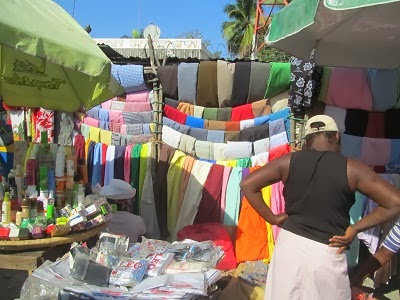
A street market in Port-au-Prince. Photo taken by Erin Taylor.

In times of crisis, then, things that compel circulation are especially useful. Bailouts, negotiations, passports, and buses are all mobilizing agents that can help get things moving along desirable paths.

Mobile phones and cash are two particularly powerful mobilizing agents. Not only do they move themselves, they help other things overcome crucial barriers to circulation. Mobile phones permit instant communication and coordination of the movement of people, commodities, and cash. Cash simplifies the process of transferring ownership of goods by making everything quantifiable and fungible. Both the mobile phone and cash store and transfer value, increasing control and mitigating risk for the people who hold them.

Money changer. Photo by Erin Taylor.
Today, the vast majority of the world’s population has access to both mobile phones and cash. This makes them possibly the most useful tools that we have today to overcome the constraints imposed by barriers to circulation, both during times of crisis and in everyday life.

Mobilizing money after the earthquake

On January 12, 2010, a 7.0 magnitude earthquake devastated Port-au-Prince and nearby areas in Haiti. With rubble covering the streets, people couldn’t easily move to find their friends and families. Emergency services struggled to reach survivors and deliver aid. Banks weren’t operational and people couldn’t withdraw or transfer cash. The main road out of town to Jacmel in the south was blocked for ten days.

Landlines ceased to be operational for months after the earthquake. Both mobile network operators, Digicel and Comcel, lost most of their capacity for a day or two, but were restored quickly relative to other infrastructures and services.

With continuing blockages to circulation, communications became particularly important. Once capacity was re-established, mobile phones took on central role in coordinate recovery and relief efforts. USAID and the Gates Foundation took this opportunity to incentivize the development of mobile money by offering $10 million in prize money to service providers who launched mobile money services within a certain time frame. By the end of 2010, there were two mobile money services in Haiti: Digicel’s TchoTcho Mobil, and Voilá’s T-Cash.

Mobile money services were used in relief and recovery efforts by Mercy Corps to deliver food aid in Port-au-Prince, Mirebalais, and Saint Marc. Given that recipients generally did not have bank accounts, using mobile money streamlined the process of delivering regular payments to the workers and displaced families registered in their programs, saving time and effort for both donors and recipients.

Everyday crises and circulation

While all economies depend upon circulation, one could argue that it is all the more crucial in developing economies where people earn uneven incomes and good may be scarce. People in wealthier countries tend to have greater stores of resources on hand, such as food in their pantry and cash in their wallets. In Haiti, the poorest country in the western hemisphere, people tend to store little of value, meaning that without circulation, a family may not eat.

A woman selling in the Marche en Fer, Port-au-Prince.
Photo by Erin Taylor.
Mobile money can help resolve everyday crises by decoupling money from the material. In Haiti, the underdevelopment of infrastructure and a lack of ways to offset risk mean that crises can be caused by fairly ordinary events. Heavy rain can bring transit to a halt in areas where there are poor roads or no bridges over rivers. For a family with school children boarding in another town, or for a person who depends upon remittances from their travelling partner, delays in receiving cash can have serious side effects: going hungry, missing medical appointments, inability to pay debts.

It would be misleading, however, to assume that keeping minimal stores of value is always an act of desperation. Anthropologist Timothy Schwartz (2009) observes that it is also a strategy to maximize profits. He writes how Haitians turn cash (including agricultural profits) over in the market rather than storing it at home:

Female market activity is so important to household livelihood that few people would dare save money by stashing it away. A person who has money will invariably “put the money to work” by giving it to a female relative or friend who will roll the money over in the market, for as they say in Jean Rabel, lajan sere pa fe pitit (stashed money bears no children).

This focus on liquidity is not just limited to cash. One man we interviewed on the Haitian-Dominican border, Luis, has his own permanent SIM card, but he acquires a new mobile phone every two weeks on average. Why? Because this is how often he travels to Port-au-Prince to buy Blu handsets and resell them, primarily to United Nations workers on the border. Luis appropriates these handsets for his own personal use rather than invest in his own because these particular handsets are quite expensive. Interestingly, Luis wasn’t so much using phones to cope with crisis as he was taking advantage of the political crises of 2004 that caused the influx of UN workers and cash.

Just as with high finance, crisis can bring both disaster and profit. Which side of the fence a household lands on can depend upon how much value they have has stored and whether it can be mobilized in productive ways. Currency and communications can be particularly useful in overcoming blockages and putting value to work.

References:
Schwartz, Timothy. 2009. Fewer Men, More Babies: Sex, Family, and Fertility in Haiti. Lexington, MA: Lexington Books.

This article is based on a paper given in a panel called Circulation in Times of Crisis (convened by Heather Horst and Marta Rosales) at the Australian Anthropological Society Conference in Canberra, 5-8 November 2013. The research was carried out with Heather Horst and Epelencia Baptiste, and funded through an IMTFI grant. 

For details on Erin B. Taylor's first project with IMTFI click here.