Monday, January 27, 2014

Lessons Learned from a Mobile Payment Pilot Project in Brazil


Inspired by cases of success in Africa and Asia, in 2011 a Brazilian public bank, an international credit card company and a mobile operator organized a joint project designed to explore the emergent field of mobile payment systems in Brazil. This was not the first mobile payment project in the country and ended up being unsuccessful. Nevertheless, it was well documented and could provide important lessons to be learned in future mobile payment implementations.

As this project was designed to promote financial inclusion, the partnership was extended to a Microfinance institution, the Banco Palmas, that since 1998 operated in Conjunto Palmeira, a poor neighborhood with more than 40 thousands inhabitants located 22 kilometers away from the most developed areas in the city of Fortaleza, northeastern of Brazil. 


Banco Palmas already had a large portfolio of financial services oriented to the poor, including microcredit, and special financial support for women, and has operated as a bank agent (i.e. correspondent banking) for commercial banks in the community. But one of its  most remarkable initiatives was the creation and management of a local, alternative social currency called “Palma”, which circulates side-by-side with the official Brazilian currency (the Real), and is accepted by the local merchants and it is good only within the boundaries of the neighborhood.  

An important expectation of this project was the digitalization and replacement of the printed social currency: as local merchants largely accept the “Palma”, it was expected that people living in that community would easily adopt its mobile version. And despite it was first designed to be a mobile payment service for users of bank accounts, it could be easily converted into the first Brazilian digital social currency.


But in fact neither occurred, and some lessons have been learned: 
  1. Definitions on governance of a partnership involving companies from different industries, with objectives and expectations not always convergent, should not be postponed to the implementation phase of the project. Especially when the opportunity is enticing, as are the innovations in financial inclusion supported by technology.
  2. Top-down projects deployments of new financial services supported by technology may find more difficulties than those initially built from the users' experience, and this is also true at the local level: a successful mobile financial service in a territory may not be suitable for another, even if the socioeconomic context is similar.
  3. Closed platforms to offer new financial services supported by technology often encounter restrictions on adoption, regulatory, technological and interoperability issues. Closed platforms commonly are interesting for entrepreneurs, and may cause significant local impact. However, from the point of view of replicability and interoperability (both technical and operational), open platforms tend to provide more benefits to users.
  4.  The adoption of new financial services supported by technology doesn't mean its effective use. The personal motivators to adoption of innovations may not be those that will influence the effective use of individuals, and again it also depends on local community factors.
  5. This project never positioned itself clearly to your potential users, and even for the partners: It was a mobile banking service for users of bank accounts; it was also explained as a mobile payments system; and often was presented as the digitalization of the printed social currency.
  6.  Mobile payments may mean very different things for the partners. The lack of a prior alignment, as well as critical issues relating to governance, concealed the different perspectives and expectations that each had for the same project. This was clearly perceived by the researchers, but not all the partners knew the motivations and intentions of others, and this hindered the decision-making process during the execution of the project.

Other factors also have contributed to the abandonment of this pilot project during 2013, on unknown date because it was never formally ended. The final report of this project can be found at: Mobile Payment for Financial Inclusion: Investigation of a Pilot Project in Brazil.

Even though it was not a successful case, this pilot project sparked the expectation of the heads of many other community banks in Brazil: the transformation of the printed social currency into a digital social money could enhance their operation and improve the users experience, because of the problems experienced with the printed social currency (fragility, durability, falsification); the profile of potential users (especially young people from poor communities) and the extent of the scope with the mobilization. An interesting video was compiled with such expectations:


By the end of 2013 the Brazilian Central Bank finally launched the new regulation for mobile payments in the country that may promote the emergence of a new ecosystem, aiming exactly the financial inclusion. In this new phase, many of the organizations involved in this pilot project are already developing new mobile payments and mobile money projects in Brazil.

You can download their final report here.

Wednesday, January 15, 2014

Warning Signs and Ways Forward: Lessons on Client Uptake from IMTFI Researchers

Insights from IMTFI research projects, a synthesis: "Warning Signs and Ways Forward"

IMTFI is devoted to supporting innovative research on the financial lives of the world’s poor and on the potential for new technologies to change the monetary ecologies in which people seek to make a life for themselves. 


IMTFI researchers have identified cross-cutting issues affecting client uptake for mobile and other electronic platforms. Some provide opportunities for developing new services or laying new products on existing platforms. Others are warning signs: recurrent themes that have impeded uptake in multiple contexts.

To date, IMTFI has supported over 105 projects in 38 different countries. This includes support for over 125 researchers, over 70% of whom are from the developing world.

Civilian seeking assistance on withdrawing remittances,
Lombok Island, Indonesia. Photo credit: Catur Sugiyanto


"Warning Signs and Ways Forward" investigates some of the recurring themes found across the first four years of research, investigating the pros and cons of digital platforms for payment and savings, while trying to show how the experiences and philosophies of the “target” populations of development initiatives themselves provide invaluable guidance for how to design and implement systems and policies that will actually benefit those they are intended to serve.

Interview with owners of small ruminants, Nigeria.
Photo credit: Isaac Oluwatayo

We emphasize that there is no one-size-fits-all proposition for mobile and electronic payment adoption. But we have also heard some of the same stories again and again, especially admonitions about potential obstacles to use.

Me and my four active phones, Afghanistan.
Photo credit: Jan Chipchase

We invite you to view the full booklet, accompanied photos from a sampling of IMTFI projects: Warning Signs and Ways Forward: Digital Client Uptake Document, November 2013

To request hard copies, please email imtfi@uci.edu.

You can see more "IMTFI syntheses" and "White Papers" here, and view additional "Work In Action" here. 

To do a search on IMTFI projects, go to IMTFI's beta search page.

Monday, January 13, 2014

Tradition and Trust: Reflections on Barriers to Mobile Payments from the IMTFI Conference

What are the costs of dealing with cash, how can we cope with spotty service providers, and what about those pesky mice eating into your savings?

Laura Freschi blogs on her experiences of the IMTFI conference over at the NYU based Financial Access Initiative.

"This theme of trust came up again in the research of Lite Nartey and Olayinka David-West, who interviewed 4,500 urban dwellers in Accra, Ghana and Lagos, Nigeria earning less than $200 a month. The researchers found that "everybody has at least three phones" because each service provider is so spotty and unreliable that three are required to get full coverage. But even with people toting around multiple phones in their pockets, many still rely on “susu collectors,” local women who collect and hold people’s money in exchange for a fee, for their savings needs...."

Monday, January 6, 2014

Cash in crisis: Mobilizing agents in post-earthquake Haiti

By IMTFI researcher Erin B. Taylor

Crisis is often linked to reductions in circulation of one sort or another. Economic crisis, such as the GFC, involves the slowing down of circulation of monetary value. Political crises, such as the recent shutdown of the US congress, see procedures of governance and statehood come to a halt. And human crises often prompt changes in circulation, such as displacement due to a natural disaster, or long stays in refugee camps.

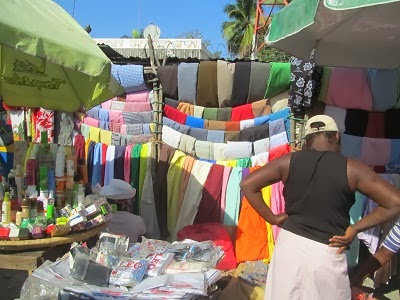
A street market in Port-au-Prince. Photo taken by Erin Taylor.

In times of crisis, then, things that compel circulation are especially useful. Bailouts, negotiations, passports, and buses are all mobilizing agents that can help get things moving along desirable paths.

Mobile phones and cash are two particularly powerful mobilizing agents. Not only do they move themselves, they help other things overcome crucial barriers to circulation. Mobile phones permit instant communication and coordination of the movement of people, commodities, and cash. Cash simplifies the process of transferring ownership of goods by making everything quantifiable and fungible. Both the mobile phone and cash store and transfer value, increasing control and mitigating risk for the people who hold them.

Money changer. Photo by Erin Taylor.
Today, the vast majority of the world’s population has access to both mobile phones and cash. This makes them possibly the most useful tools that we have today to overcome the constraints imposed by barriers to circulation, both during times of crisis and in everyday life.

Mobilizing money after the earthquake

On January 12, 2010, a 7.0 magnitude earthquake devastated Port-au-Prince and nearby areas in Haiti. With rubble covering the streets, people couldn’t easily move to find their friends and families. Emergency services struggled to reach survivors and deliver aid. Banks weren’t operational and people couldn’t withdraw or transfer cash. The main road out of town to Jacmel in the south was blocked for ten days.

Landlines ceased to be operational for months after the earthquake. Both mobile network operators, Digicel and Comcel, lost most of their capacity for a day or two, but were restored quickly relative to other infrastructures and services.

With continuing blockages to circulation, communications became particularly important. Once capacity was re-established, mobile phones took on central role in coordinate recovery and relief efforts. USAID and the Gates Foundation took this opportunity to incentivize the development of mobile money by offering $10 million in prize money to service providers who launched mobile money services within a certain time frame. By the end of 2010, there were two mobile money services in Haiti: Digicel’s TchoTcho Mobil, and Voilá’s T-Cash.

Mobile money services were used in relief and recovery efforts by Mercy Corps to deliver food aid in Port-au-Prince, Mirebalais, and Saint Marc. Given that recipients generally did not have bank accounts, using mobile money streamlined the process of delivering regular payments to the workers and displaced families registered in their programs, saving time and effort for both donors and recipients.

Everyday crises and circulation

While all economies depend upon circulation, one could argue that it is all the more crucial in developing economies where people earn uneven incomes and good may be scarce. People in wealthier countries tend to have greater stores of resources on hand, such as food in their pantry and cash in their wallets. In Haiti, the poorest country in the western hemisphere, people tend to store little of value, meaning that without circulation, a family may not eat.

A woman selling in the Marche en Fer, Port-au-Prince.
Photo by Erin Taylor.
Mobile money can help resolve everyday crises by decoupling money from the material. In Haiti, the underdevelopment of infrastructure and a lack of ways to offset risk mean that crises can be caused by fairly ordinary events. Heavy rain can bring transit to a halt in areas where there are poor roads or no bridges over rivers. For a family with school children boarding in another town, or for a person who depends upon remittances from their travelling partner, delays in receiving cash can have serious side effects: going hungry, missing medical appointments, inability to pay debts.

It would be misleading, however, to assume that keeping minimal stores of value is always an act of desperation. Anthropologist Timothy Schwartz (2009) observes that it is also a strategy to maximize profits. He writes how Haitians turn cash (including agricultural profits) over in the market rather than storing it at home:

Female market activity is so important to household livelihood that few people would dare save money by stashing it away. A person who has money will invariably “put the money to work” by giving it to a female relative or friend who will roll the money over in the market, for as they say in Jean Rabel, lajan sere pa fe pitit (stashed money bears no children).

This focus on liquidity is not just limited to cash. One man we interviewed on the Haitian-Dominican border, Luis, has his own permanent SIM card, but he acquires a new mobile phone every two weeks on average. Why? Because this is how often he travels to Port-au-Prince to buy Blu handsets and resell them, primarily to United Nations workers on the border. Luis appropriates these handsets for his own personal use rather than invest in his own because these particular handsets are quite expensive. Interestingly, Luis wasn’t so much using phones to cope with crisis as he was taking advantage of the political crises of 2004 that caused the influx of UN workers and cash.

Just as with high finance, crisis can bring both disaster and profit. Which side of the fence a household lands on can depend upon how much value they have has stored and whether it can be mobilized in productive ways. Currency and communications can be particularly useful in overcoming blockages and putting value to work.

References:
Schwartz, Timothy. 2009. Fewer Men, More Babies: Sex, Family, and Fertility in Haiti. Lexington, MA: Lexington Books.

This article is based on a paper given in a panel called Circulation in Times of Crisis (convened by Heather Horst and Marta Rosales) at the Australian Anthropological Society Conference in Canberra, 5-8 November 2013. The research was carried out with Heather Horst and Epelencia Baptiste, and funded through an IMTFI grant. 

For details on Erin B. Taylor's first project with IMTFI click here.

Wednesday, December 18, 2013

Reflections: Carol Benson and FAI look back at IMTFI conference

Carol Benson reflects on the recent IMTFI conference, and one of her biggest takeaways: mobile money and payment systems are complicated.
Many of the surprises came from insight into how complicated financial management is, from a human dimension, for many of the subjects of these studies.  And “complicated” isn’t necessarily bad: sometimes, it is just a description of reality.  Money, after all, plays an important role in complex family relationships, employment situations, and community obligations. 
In developed countries, relatively affluent payments professionals may think that their estate planning, or mortgage financing, or college funding strategies are complicated, and that their “payment life” is simple.  (Although, for some rewards junkies, even that “payment life” is complicated, as they try to figure out which card gives them the most points!)  But all people, poor or not, have ways of dealing with the intersection of money and the complications of life.  Assuming that poverty makes this simple is just wrong.  The IMTFI researchers are doing a great job of illustrating this.
Read her entire post here.
_____________________

Financial Access Initiative's Timothy Ogden and Laura Freschi highlight the importance of mobile money on the FAI blog: "One of the issues we follow closely at FAI is the rapidly expanding use of mobile money in the developing world.....


Sunday, December 8, 2013

Showing and Telling: Corridors, Networks and Agents


The final panel of the conference focused on "the Indian Case" to wrap up the two-day public conversation about money, technology, and financial inclusion efforts happening around the developing world.

"The New Information Ecosystem Being Developed Around Mobile Money: A Behavioral Analysis of Mobile Money Users in India" by Lakshmi Kumar noted that banking access remains at just 50% in India, while tele-density measures in at about 75%,  With migrants constituting about a third of the total population, and women constituting about 70% of migrants, Kumar wanted to ask why mobile money was considered preferable to bank accounts or post office money management.  She noted that address documentation was not required for mobile money, which could be important as migrants switch from rural to urban settings.  Nonetheless, numerous studies also point to greater confidence in "cash in hand" and suspicion of the role of middleman.  In comparison with other remittance practices, mobile money users sent more money, and those numbers increased with age and education.  There was also a significantly higher use among men.  Mobile money users also sent 34% more emergency money than non-mobile users, which also correlated to marital status.  She examined the practices of migrant workers who labored in professions such as construction worker or truck driver, who earned a relatively robust 14,000 rupees in monthly wages and were able to remit money back home frequently from weekly paychecks; she also studied non-mobile users, who tended to earn only about 6,000 rupees in her sample.  (You can see an account of Kumar's earlier work in Tamil Nadu, which was presented at the 2010 IMTFI conference here.)

Many in Chennai also benefitted from a what Kumar called a "sub-eco system" created through interventions by employers to facilitate electronic transfers to save time.  Money in this system went to bank accounts in the migrants' states of origin, and the receipt for the transaction would arrive in their mobile phones.  Thus mobile money users never wanted paper receipts, and trust was created immediately.  This factor of trust may explain why one product -- remittance -- gained so much trust in comparison to other products and services that could not be rapidly verified by kin.  Trust was also built through relationships with the people to whom they went to to charge their mobile phones and seek other services associated with mobile telephony.  This huge population of mobile money users could be part of a financial inclusion strategy that was "MNO & bank agnostic." Kumar also showed footage from a short film showing her informants that asserted that "remittance is the beginning of saving" and that the owners of stores pursued a marketing approach dictated by "pull" rather than "push" interactions.


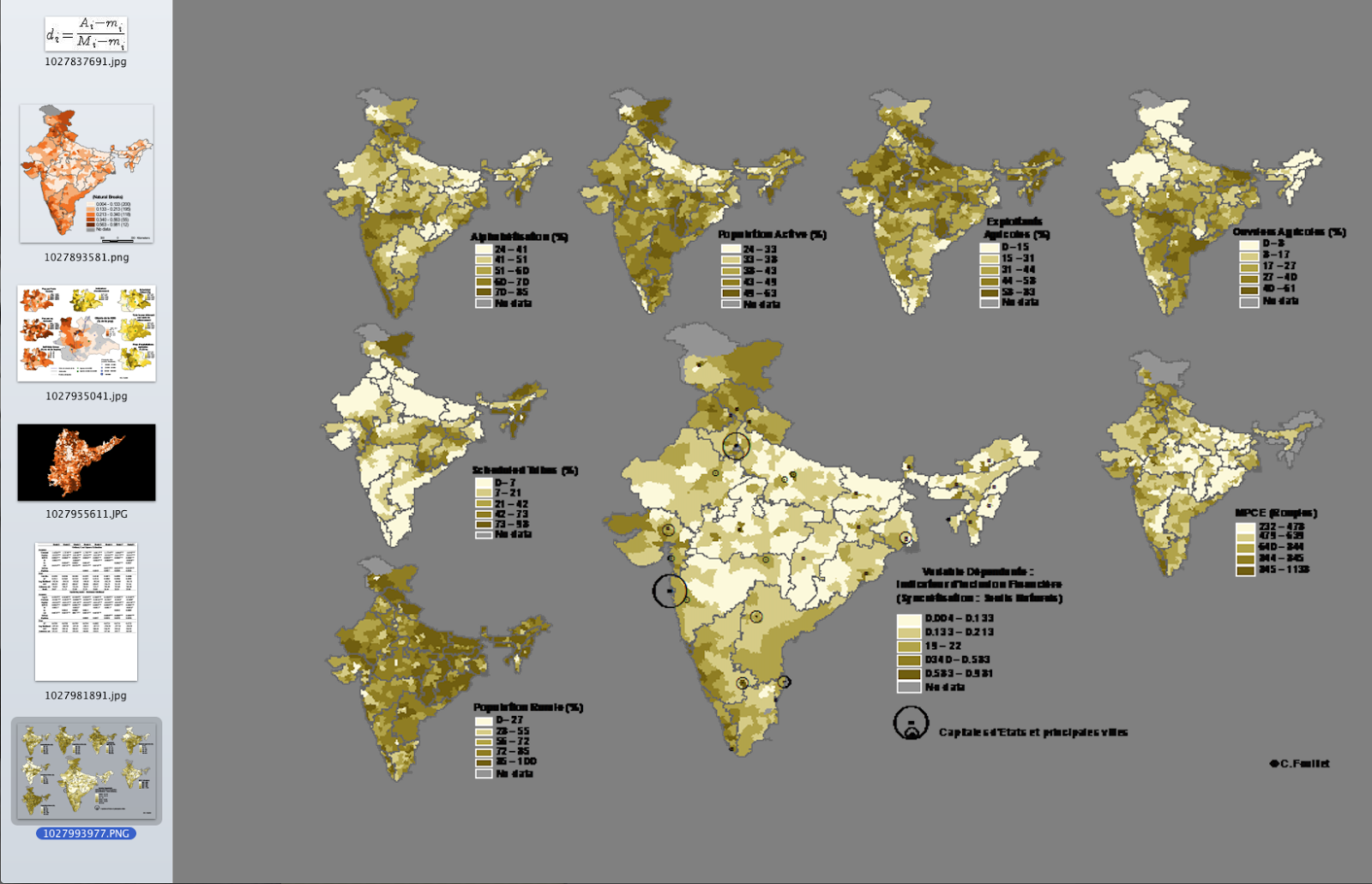
"Spatial Complementarity of Mobile Financial Services, Business Correspondents and Banking Infrastructures: Accounting for Mobile Financial Services Ecosystems in India" by K.V. Nithyanada and Cyril Fouillet emphasized "speaking about space and financial inclusion," for example by showing a map of financial exclusion created from data from CGAP.  In beginning his presentation, Fouillet indicated his own scholarly debt to Susan Johnson and her work on financial inclusion in Kenya.  (See the Center for Financial Inclusion for more about related work.)

The Fouillet and Nithyanada team was doing the pilot data collection to support their visualization efforts by surveying banking correspondents, bankers, microfinance officials, and stakeholders at NGOs.  To better refine the indices of financial inclusion, they were producing maps at the district level for the entire nation and at the block level for Andhra Pradesh (Fouillet's field site) and Tamil Nadu (the field site of Nithyanada).  This ambitious mapping would also capture legal and regulatory environments and the landscape of the implementation of policy at ground level.  To make granular distinctions, researchers would like to deploy small electronic gadgets and operationalize business correspondents in India, although information from financial institutions would also include banking penetration, the available of banking services, and the use of banking services  Such visualizations could also potentially allow researchers to test hypotheses.  Researchers were still developing questionnaires and had not yet finalized sample size, but their recognition that money was a "highly political" commodity that merited the same kind of mapping efforts devoted to the state that might capture money in India in its "various dimensions." As they closed they cited  David Harvey, who famously argued that "money concentrates social power in space."

"One Among Many? Examining the Efficacy of Mobile Money in India's Remittance Corridors" by the extraordinary undergraduate student Amrit Pal noted that one third of all remittances occurred between two corridors -- between Bihar and Mumbai and between Andhra Pradesh and Delhi -- as mobile money users navigated between the aspirational extremes of the village and the city.  Pal described financial realities of migrants in satellite cities doing unskilled labor, such as rickshaw drivers and operators of manual handlooms.  He reminded that his research could only track the sending party, who constituted the more empowered users in the exchange, because they could choose channel and partner.

Pal showed the layout of space in establishments that offered mobile money services and the immersive branding of multiple remittance providers.  Although the establishment might be "one store" of "many purposes," remittance would be at "the heart" of the customer's visit.  From pitching the  Chennai Express to marking the festival of Eid, the visual appeals he showed often targeted a logic of rhetorical occasion.  He observed the importance of competition fueled by the kiosks and hawala discussed on day one of this year's IMTFI conference.  He pointed out that most transfers were immediately withdrawn at the bank branch as well.  Although he described a "vibrant ecosystem" with multiple products, he said that the reality be less "warm and fuzzy" than it might seem" because of "gaping systemic faults," which included "no clear mandate from regulators and banks."  There was also "no testing out of which channel that works" in an environment of hypercommodization and competition in which mobile money was treated like "detergent," and the customer purchased "the cheapest one that works."  Yet unlike detergent mobile money "may not scale."  Furthermore, agents might try to cut corners by going to the bank rather than through Eko, so that new corporate actors aren't given opportunities,  He also bemoaned the fact that "the largest bank had four mobile money products that essentially do the same thing."  In closing, he cautioned against "Big Brother" decisions and acknowledged that it was "not clear if mobile money will lead the way or follow the way" based on the lessons of the telecom market.

Discussant Abhishek Sinha, Eko India Financial Services Private Limited joked about the jargon of "econometric," "spatial," and "regression" in the abstracts of papers that ultimately turned out to be refreshingly plain spoken about research.   Sinha also raised questions about the use of middlemen - seeking higher positions while also granting that "assistance" served as "a big phenomenon in India," where people often spurned self-service, which may be available but not appealing from a "behavioral" standpoint.  During the Q&A there was a lively discussion that was spurred by the provocations of UCI Professor Alladi Venkadesh on the importance of making translations and not letting Western thinktanks control the agenda.


Bill Maurer wrapped up the IMTFI conference by emphasizing the fact that "the world has never seen the adoption of a single platform for money and value." He recounted his conversation with Carol Benson yesterday about mobile money as "a new rail" in an "interlocking system of rails" rather than "one whole system."  (Benson has a great post at Payments Views about the conference.)

If mobile money can be visualized as a bridge, Maurer asked "what sort of bridge is it?" "Is it a bridge for carrying money?" He summed up the conference by referencing "the person-to-person bridges between gold and loans," "a bridge between friendship circles," "a bridge between one cosmoeconomic system and another," a bridge between Islamic banking on orthodox terms and Islamic banking in everyday terms, and even "a bridge between life and death."  Certainly mobile money served as a bridge between informal and formal practices, according to IMTFI's sponsored researchers, but the bridging might be still poorly understood.

Maurer cited Ignacio Mas on "bridges to cash," to state wryly that mobile money could also be "a bridge to cashlessness" or to the "cash-lite" state of Dzokoto and Imasiku or the "cash heavy" state imagined by  Scott Mainwaring.  He opened up his own wallet to show ATM receipts as "consumer protection devices" and threw a bill to the floor to dramatize the fact that "cash is not account based," "cash settles at par," "cash settles immediately," and that with cash "title passes to the bearer" even if we might debate whether the bill-throwing is a gift or a performance.  In grappling with much more complex phenomena described at the conference and "all the externalities in the cash cycle," Maurer reminded them that the moral picture could range from ATM fraud to the benevolent Njangi practices of Cameroon.

Thursday, December 5, 2013

Betting Against the House: Chance, Risk and Fraud


The only all-male panel at the IMTFI focused on risky monetary behaviors.  The presenters led off with a talk about "Gambling and Mobile Money Payments: A Case Study of Sports Betting in Uganda" by Bruno Yawe and Kizito Ssengooba that focused on how value creation and value destruction might be interrelated in the field. They observed that 25% of sports betting shops were licensed (37 out of 104 enterprises) and that mobile money was used for twenty-four hour betting, which was especially popular among working class participants.  (Football was apparently the number one sport for betting activity, according to the researchers.)  


They focused their attention on six online betting shops and on questions about the regulatory environment, the addictive nature of betting, possible links to youth poverty, and mechanisms for redress in rigged and one-way gambling operations.  Some of the most dramatic narratives involved students missing graduation after tuition money had been gambled away.

"Challenges Facing the Uptake of M-Insurance Loyalty Based Life Insurance Schemes: A Case Study of the yuCover Microinsurance scheme in Kenya"  by Nelson Karani Nyachiro and Cyrus Isaboke focused on services offered by yuMobile in partnership with Jubilee Insurance and Micro Ensure,  The yuCover insurance scheme rewarded subscribers with renewable monthly life and disability coverage.  Nonetheless researchers found that belief and culture propagated biases that insurance was for old men and the owners of motor vehicle owners, and even one of the researchers confessed to being among the uninsured.


The final panel on "Automated Teller Machine Fraud in South-West Nigeria: The Shoe-Wearer's Perspective" by Oludayo Tade and Oluwatosin Adeniyi opened with a recap about the fun of participating in a conference in which economists used to crunching numbers could also hear about sorcery and comic books.  Their study focused on the life chances of victims after ATM fraud and emphasized Victims Precipitation Theory (VPT), Lifestyle Theory (LT), and Routine Activity.  The methodology mainly adopted a snowballing approach.  They discovered that the fraudsters identities tended to be kin, lovers, children, and friends, although non-kin third parties could also be victimizers.  Victims often had 2-5 ATM cards and were plagued by illiteracy, illness, or old age and weak constitutions, although even an economics professor had been victimized, according to the researchers.  Despite the protections of PIN numbers and daily limits, there was no shortage of sad story, including the tale of a man who needed help with pushing buttons who was cheated and five young people finishing national service who found their accounts emptied. Such fraud could have particularly destructive effects on students.  It could also lead to business collapse, as well as undermining the entire purpose of saving among community members.  A culture of blaming victim or of officials being unwilling to use footage from CCTV to catch perpetrators could worsen the situations.  It was also interesting to hear about the appropriations and improvisations that banks and users deployed, which included constructing screens to block views of PIN entry.

Discussant Jan Chipchase of frog design asked presenters to reflect about how their own life practices had been changed by their research.  He also pushed the question of whether "exploring topics that are taboo in shape or form or touching on taboo topics" might require researchers "to get participants' perspectives" by joining in  He even suggested that it might be "an obligation to go down that road."