Showing posts with label conditional cash transfer programs. Show all posts

Tuesday, November 29, 2016

What Are the Effects of Adding Credit and Insurance To a Conditional Cash Transfers Program in Mexico?

Manuela Angelucci, Carlos Chiapa and Silvia Prina 

Recent research suggests that chronic complexity and stress inherent in the lives of the poor can impede and hamper financial decision-making. Due to pressing short-term needs of the here and now, forward-looking behaviors, such as investing in education and health, may not get prioritized by the poor. Even with the knowledge and means, making changes in behavior (such as more time parenting or other healthy activities that could have far-reaching consequences) is challenging due to the lack of adequate resources.

Since a major source of anxiety in the life of the poor is related to financial complexity and uncertainty, for our project we assumed that simplifying the financial lives of the poor would create favorable circumstances for them to recognize the longer-term benefits of and willingly invest in their children’s education (through parenting and schooling) and adopt healthy behaviors. In addition, we anticipated that making the financial lives of the poor more straightforward would have a positive effect on their welfare.

Our focus group interviews with poor households in Mexico corroborated past research in showing that financial instability and emergencies are a major source of stress and anxiety. Therefore, for our target population we hypothesized that access to credit and insurance would improve the ability to cope with immediate shocks and that, in turn, these gains might promote the psychological well being of the poor and favor investing resources in education and health. We also had two more specific hypotheses: (1) recipients of the conditional cash transfer plus credit and insurance would have better parenting and higher adherence to healthy habits than recipients of only the basic conditional cash transfer; (2) experiencing unexpected income shocks reduces healthy habits and quality of parenting by adversely affecting psychological health, but this is less so for recipients of the conditional cash transfer plus credit and insurance.

We tested these hypotheses using as our target population the recipients of PROSPERA (formerly known as Oportunidades), Mexico’s flagship conditional cash transfer anti-poverty program, which covers approximately 25% of the Mexican population. This is a policy-relevant target population for two reasons. First, because conditional cash transfer programs targeting the poor are implemented in at least 33 countries worldwide and serve 90 million people in Latin America alone. Second, because the typical conditional cash transfer program requires its recipients to have regular health checks and provides them with health and nutrition education, both of them free of charge. Therefore, we target a population that has neither knowledge nor financial constraints to the adoption of health behaviors, but rather those whose mental wellbeing may be hurt by the stress and complexity of their lives.

The recipients, almost all women, received cash transfers in a bank account every other month. In addition, a subset of participants received additional benefits from a financial inclusion module called “Programa Integral de Inclusión Financiera ‘Prospera más con BANSEFI” (PROIIF), a supplemental program that provides beneficiaries with additional benefits at below-market prices. In particular, the main objective of PROIIF is to improve PROSPERA’s beneficiaries’ formal financial inclusion. Through PROIIF beneficiaries have access to the following products: an additional savings account (Ahorro Más con BANSEFI); two lines of credit at an interest rate substantially below market levels (Crédito Básico Más con BANSEFI and Crédito Más con Ahorro); a life insurance policy at a discounted price (Seguro Más con BANSEFI); and additional benefits (Paquete de Beneficios Adicionales BANSEFI).

To test hypothesis (1), we compared healthy habits, parenting, children’s schooling, mental health, cognition, stress and total household income of PROIIF and non-PROIIF households. The difference in outcomes for PROIIF and non-PROIIF recipients identified the average treatment effect of PROIIF under the assumptions that (i) PROIIF affects only its recipients and not other subjects (e.g., it rules out spillover effects of PROIIF) and (ii) there are no systematic differences between PROIIF and non-PROIIF recipients.

The first assumption is likely to hold because PROIIF and non-PROIIF recipients were geographically distant from each other. Therefore, spillover effects are unlikely. To check the validity of the second assumption, we compared the predetermined socio-economic characteristics of PROIIF and non-PROIIF recipients and their households. We find that these two groups of recipients and their households are fairly similar.

Figure 1. shows that healthy habits, parenting, children’s schooling, mental health, and cognition do not differ between PROIIF and non-PROIIF beneficiaries, thus rejecting our first hypothesis.

Figure 1.

To test hypothesis (2), we compared the healthy habits, parenting, children’s schooling, mental health, and cognition of households that have and have not suffered from unexpected shocks in the previous 14 days prior to the interview date. Since the experience of unexpected shocks may not be random, as poorer and more vulnerable households are more prone to suffer these shocks, we restricted the sample to households who had experienced at least one unexpected shock in the previous 12 months. Therefore, the variation that we exploited was in the timing, and not the experience, of these shocks. 

The difference in outcomes for households that were hit by an unexpected shock in the previous 14 days and households that experienced these shocks in the previous 12 months (but earlier than two weeks before the interview date), identified the effect of unexpected shocks under the assumptions that (i) the shocks affect only their recipients and not other subjects and (ii) there are no systematic differences between households that experienced the shocks sooner and later. 

Spillover effects of these shocks are unlikely, as only 7.16 percent of the sample experienced shocks in the previous 14 days prior to the interview date and these households were geographically spread out, so the data supports the first assumption. Moreover, the socio-economic characteristics of the two groups of households were similar, and consistent with the second hypothesis. 

Figure 2. shows that transitory and more permanent shocks reduced the income of PROSPERA’s beneficiary households by similar magnitude as the effects on income were not statistically different from each other. Permanent shocks did not consistently or overall significantly reduce adherence to healthy financial habits. Similarly, we see no effects on schooling or parenting, or on parental aspirations and expectations for their children’s schooling. 

Figure 2.

Further analysis shows that the magnitudes of the shocks of more permanent and transitory shocks on the outcomes of interest are not statistically different for PROIIF beneficiaries. There are two exceptions. First, receiving PROIIF attenuates the negative effects of experiencing transitory income shocks on household income. Second, while receiving PROIIF does not attenuate the negative effects of experiencing more permanent income shocks on income, it increases the amount of time desired to spend with children. 

Overall, findings from our data indicate that recipients of the conditional cash transfer plus credit and insurance do not seem to have better parenting and higher adherence to healthy habits than recipients of only the basic conditional cash transfer. In addition, while it is the case that experiencing unexpected transitory income shocks reduces income, the magnitude of the effect is lower for recipients of the conditional cash transfer plus credit and insurance. Finally, when experiencing more permanent income shocks, the quality of parenting by increases for recipients of the conditional cash transfer plus credit and insurance.

Read more in Angelucci, Chiapa and Prina's Final Report

Tuesday, June 21, 2016

"M-money as Conduit for Conditional Cash Transfers in the Philippines" in ITID Special Issue

Erwin A. Alampay and Charlie Cabotaje have a new article, "M-money as Conduit for Conditional Cash Transfers in the Philippines", published in Information Technologies & International Development (ITID)'s Summer 2016 Special Issue CPRsouth.  

This special issue CPRsouth (Communication Policy Research South) — guest-edited by Alison Gillwald — features articles that examine challenges facing ICTs in a range of countries in the Global South from diverse perspectives. In the context of the Global South, and Africa in particular, although prepaid mobile communications services have largely driven connectivity, public-interest research in areas of ICT policy has so far been limited and the simple transposition of “best practice” from the Northern hemisphere have often failed to procure desired outcomes. The collection of articles in this special issue examine how the deployment of new services, apps, improved methodologies, or governance frameworks could contribute to more inclusive, locally appropriate and effective regulation that enhance well-being, livelihoods, democracy, and economic participation. Following the theme of the CPRsouth 2014 Conference on What works, why and how do we know?, the articles seek to understand how governments and enterprises, particularly in developing countries, can effectively use ICTs to meet broader socioeconomic objectives and poverty-reduction strategies. The entire collection of articles published on June 10, 2016 is accessible at http://itidjournal.org.

Of special interest in the issue is the article by Erwin A. Alampay and Charlie Cabotaje, based on their research funded by IMTFI:
"M-money as Conduit for Conditional Cash Transfers in the Philippines", Information Technologies & International Development [Special Issue], 12(2), pp. 1-12. 

Article Abstract
Many developing countries provide conditional cash transfers (CCTs) for their poorest families. In the Philippines, CCT use has expanded rapidly such that in five years the amount of transfers increased by 3,300%, with PHP34 billion (US$801 million) disbursed in 2013. This expansion of deliveries has complicated government logistics. In an effort to reach the poor in all areas of the country, the government partnered with the telecommunication firm Globe’s network of GCash merchants to provide direct cash payouts to CCT beneficiaries. This article investigates the CCT implementation through the cash-based GCash Remit system to determine its effectiveness, efficiency, and security. A cost comparison was done between the GCash Remit mode of CCT delivery and the potential use of noncash mobile money (m-money) platforms already in the market. The study is based on field observations, a randomized survey of 194 CCT beneficiaries, interviews with CCT program implementers and m-money providers, and scrutiny of the tariff data of m-money providers.The full article can be accessed here.

Dissemination Event 
Erwin A. Alampay and Charlie Cabotaje disseminated findings of their study at the event held last week: "mBOP: The Impact of Mobile Financial Services in the bottom of the pyramid" (June 17, 2016). The event brought together cash transfer agencies, NGOs and other stakeholders including banking associations, USAID, Oxfam, Save the Children, and DSWD, Land Bank. Another successful example of researchers influencing policy, congratulations!


Photo credit: Charlie E. Cabotaje

Read more about Alampay and Cabotaje's IMTFI research here. And check out their IMTFI research-related blogposts:
"Conditional Cash Transfers in the Philippines (part 2 of 3)"
"Leveraging conditional cash transfers to develop local mobile money ecosystems (part 3 of 3)"

Saturday, January 3, 2015

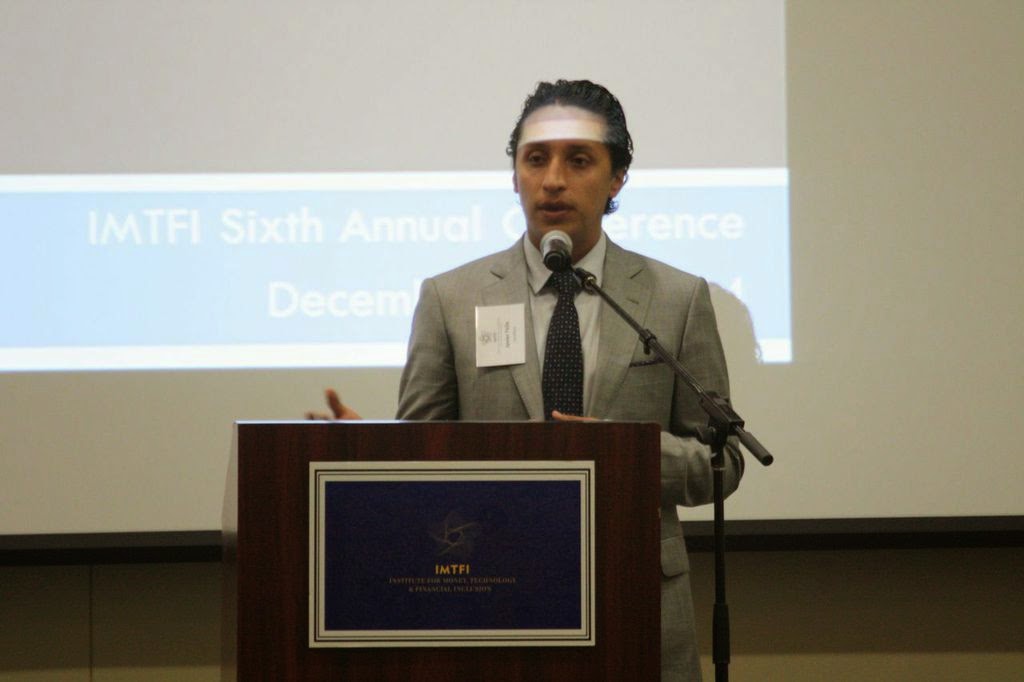
Moving Research Applications into Circulation: Putting Knowledge to Work


The final session of the IMFTI conference focused on research applications.  "Putting Knowledge to Work" was moderated by discussant Michael Joyce of TNP2K (the Indonesian National Team for the Acceleration of Poverty Reduction) who noted that Indonesia had already opened electronic accounts for a million people receiving government-to-person transfers.  He also thought that IMTFI research would be important in ensuring the success of such programs to get people to actually use the "next generation" full suite of tools realized by leading service providers in places such as Kenya with services such as  M-Shwari that had interest-based saving, credit, and more sophisticated models than existing microcredit paradigms.

The first paper on "Effectiveness and Challenges of Using Mobile Money Service in the Implementation of the Social Assistance Grants for Empowerment Programme: A Case of Kiboga District in Uganda" by Julius Okello and Dorothy Massa of the African Institute for Strategic Research Governance and Development  emphasized a G2P case in the Kiboga District of Uganda. Okello explained that SAGE (Social Assistance Grants for Empowerment) was the first major social protection initiative by the government of Uganda and how it was an arm of expanding social protection under the Ministry of Gender, Labour and Social Development. It received funding for launching its services from DFID, Irish Aid, and UNICEF, and it is also supported by Maxwell Stamp, a UK based consulting firm.  Okello explained that SAGE was a five-year pilot program which started in 2011 in Kiboga, Kaberamaido, and Kyenjojo but was later rolled out to another 11 districts.   Researchers noted that Kiboga has a population of 148,606 people, of which 4,808 citizens, both male and female, participate in SAGE.  SAGE targets elderly citizens, those from intact heritage cultures, and other vulnerable populations.

According to Okello, the MTN mobile money service was launched in the country in March 2009 and has registered 1,553,770 users since. He asserted that this translates into an adoption rate of 64,740 persons per month.  On average the relative market share of MTN Mobile Money, ZAP, and M-Sente between March 2009 and February 2010 was 89.6 percent, 9.1 percent, and 1.3 percent, respectively. Given the history, coverage, and capability of MTN Uganda, the government opted to hire MTN mobile services to remit funds to SAGE beneficiaries.  The use of mobile money in Uganda is still relatively new, according to Okello, however.

Okello's study used a mixed methods approach that combined quantitative and qualitative information gathering and was inspired by Creswell & Plano-Clarks' 2011 manual for researchers.   The Kiboga project was designed to consult about three hundred informants.  Quantitative methods included regression analysis and involved statistical figures, tables, and graphs, while the group's qualitative methods emphasized detailed explanation with evidence about their informants' livelihoods.  He showed a complex circuit of stakeholders in the project, who included the government of Uganda, the Bank of Uganda, development partners, The Ministry of Gender, Labour, and Social Development, the Uganda Communications Commission, MTN, MTN district agents, the district coordinators of ESP, and the SAGE beneficiaries themselves.  Because Uganda is one of the worst countries in the world for corruption, according to Okello, the hope is that this system of checks and balances will protect SAGE constituents.  He also worried about potential complaints from telecommunication companies that might feel "locked out" of participation.


For elderly participants without cellphones, MTN created a variety of devices and services, including this yellow box that performed all of the functional financial operations of MTN transfer services.  Yet MTN has relatively limited coverage outside of the capital, so money sometimes cannot reach the beneficiary and becomes diverted to other parties through corruption and fraud.  Unfortunately researchers found that the elderly are often targets who unwittingly share pin numbers because they are reluctant to travel the distance to the point of contact with mobile money agents or are too gullible when told that machines have broken down. In concluding Okello argued that the elderly could still be vibrant economic actors capable of launching businesses, and he closed with hopeful stories of growing sunflowers, poultry, pineapples, and piglets and an anecdote about how ritual slaughter is combined with the seeming windfall of mobile money.


Another G2P program was featured in "Paying Conditional Cash Transfer Programs in Bank Accounts" by Enrique Seira of ITAM-QFD, and the panel shifted its focus to Mexico, where it was also possible to analyze characteristics of debit card owners and their behaviors as consumers.  Seira noted that in Mexico debit card owners have three times more tertiary education, three times more savings, and more trust in general in society and institutions.  (One Seira survey question asked if informants thought that a lost wallet would be returned to measure such trust.)  Debit card owners tend to live in municipalities with 20% more ATMs per capita.  In contrast, Oportunidades “Debit” beneficiaries, who were not self-selected by their decision to get a card and used accounts relatively little, as described in this earlier IMTFI panel.  Seira noted that they also had significantly less education, and although about 45% claimed to have savings, only about 10% had "formal" savings.  This amount of savings represented about 1/50 the numbers common in the general population.  A comparison of late vs early debit card owners in Oportunidades showed that they were similar, which was good for measuring the impact of debit card expansion, as the cards became able to work in ATMs and be accepted in stores.

Seira claimed that the aspect that influenced the value and use of the account was its convenience, although a savings account with no branch nearby and no card able to pay in POS devices was not very useful.  Unfortunately, this was how Oportunidades (Mexico’s main CCT program) operated pre-2009. Of about 1 million savings accounts, none had ATM/Debit card features.  In 2009, Oportunidades started awarding Debit ATM cards in a staggered fashion. Expansion was decided by Oportunidades at the local level (not by bank branches).

Seira has planned to do a DID analysis of the effect of ATM/debit on savings in recipients' accounts. He noted that his sample was based on data on account savings for 342,000+ beneficiaries of 308 Bansefi branches in 411 municipalities during a period covering 17 bimesters: January 2009 to October 2011 (5 bimesters pre-treatment and 12 post, max).  About 70% of participants received an ATM card during the researchers' sample period.  There were three group studied: early switchers, late switchers, and those who had not yet switched.  The three groups were distributed geographically across the country and included similar distributions of indigenous groups.  Although seemingly counter-intuitive, Seira also posited that debit cards could impact savings behavior positively, because withdrawals could be smaller and done in a more controlled manner.  He acknowledged that yesterday's IMTFI session with Jonathan Morduch reached the opposite conclusion that plastic could encourage more irresponsible spending behavior.  Subjects in Seira's study ultimately saved 30% more than non-implementers, although this behavior often took six months to manifest itself.  It also often followed a pattern of significant variation among users, and research indicated that subjects had relatively low financial literacy regarding ATM use and fees.  He observed that new users also frequently checked balances, because they were distrustful about money remaining in the account.

Researchers also found evidence of early implementation problems, especially involving emigration to debit card accounts.  Surveys were also given to 100+ personnel from ATM providers, and those serving in early adopting municipalities seemed to have less knowledge about training materials.  There were also surveys distributed to 5000+ beneficiaries, which revealed that early adopters (even if they have had more time to learn) needed more help to use ATM card than late adopters (57% vs 50%, 5% significance).  While 32% of early adopters knew they had a savings account, only 30% of early adopters knew (10% significant).  Late adopters did 35% more ATM purchases per bimester.  According to Seira, there seemed to be increasing use and trust with time as well.


The final formal presentation at the IMTFI annual conference was "The Use and Impact of M-Shwari as a Financial Banking Product in Urban and Rural Areas of Kenya" by Jane Mutinda of Kenyatta University and Ndunge Kiiti of Houghton College and Emory University.  You can read more about previous IMTFI research produced by Kitii and Mutinda's collaborations here.  Mutinda credited Professor Charles Nzioka of Nairobi University, who also participated as an author in their findings presented this year.  Monique Hennik of Emory served as a consultant to improve the group's training, because the university students that they used as field researchers came from many different institutions.


Mutinda opened her presentation with a gorgeous and evocative video that explained that the Jua Kali (the word refers to the heat of the sun) were self-employed people working in the informal sector of the Kenyan economy doing 90% of the service work, which included masonry, plumbing, carpentry, metal working, and many artisanal trades.  According to experts shown in the film, this sector also employs about 19 million people and is critical for successful development.  Even the economic commentators described their own experiences as Kenyans in the bankable population as very difficult, so that someone might have to walk dozens of kilometers to make just one transaction.  People in the Jua Kali sector found opening and maintaining accounts particularly challenging, although access to resources, small loans, and savings for small businesses were all among their critical needs.  In the film researchers argued that Safaricom needed to do more outreach and education to explain the product, which was less widely in use in rural areas divorced from cosmopolitan populations of users and which privileged English speakers over those who communicated in Swahili or tribal languages. 


Kiiti took over the presentation after the video to explain the "why" and the "how" of the project, which built on their earlier work in mobile money in Kenya.  They also observed increased use of the M-PESA platform and an expansion of Safaricom bank partners providing mobile money services and products.  In addition to M-Shwari, provided in conjunction with the Commercial Bank of Africa (CBA), Kiiti also noted the existence of M-Kesho with Equity Bank and M-Benki with Kenya Commercial Bank.  Researchers chose to focus on M-Shwari, which was introduced in 2012, because it allowed subscribers to save and borrow from their phones and to earn interest on money saved.  It also provided access to credit and a paperless form of financial transaction.  Nonetheless, more needs to be done to reach the unbanked: apparently CBK has estimated that over Kshs. 300 billion ($3.5 billion) sits outside formal banking systems, and millions of Kenyans are still unbanked.  She noted that 50% of people using M-PESA still did not have a bank account.  Researchers also consulted with Safari.com to attempt to influence policy, although they were wary of possible influence.

Kiiti summarized from research highlights that indicated that M-Shwari loans were "essential in providing quick cash-flow for the Jua Kali businesses."  She also cited a number of strong assertions from those in the financial sector about the power of this product, including Michael Joseph, Director of M-Pesa within Vodafone, who argued that "M-Shwari is a 'transformational service'; saving is no longer the privilege of the elite."  She justified the study's focus on the Jua Kali, by emphasizing the fact that the informal sector contributes about 18.4% of Kenya’s GDP while creating 74% of all new jobs annually, although researchers were sometimes stymied by a lack of data.  She incorporated research done by the Africa Development Bank in her presentation as well, and argued that Kenyans rely on the Jua Kali sector for services and feel strong investments in those communities. She explained that workshops continue to be part of their research study design.

The study trained 15 graduate students and professionals.  Students came from six different campuses and were tested on their cultural/language representation (both vernacular & national).  Their training in a mixed methods approach included role-playing and practice listening, probing, and note-taking, and they included M-Shwari representatives in the process.  8 counties were and 4 regions were included in their fieldwork.  Consent was very important given the nature of the very personal questions asked by researchers about money.   160 Questionnaires were gathered with 10 users and 10 non-users of M-Shwari in each county.   Researchers examined sample characteristics, such as access/convenience, usage, gender, and sectors and found trends that involved social status.  As the research team moves forward they hope that the link/gap between marketing or promotion and knowledge or application could be better addressed if policy and practice questions receive more attention.  Obviously researchers felt that their findings could be very significant for issues of financial inclusion and exclusion in mobile banking in Kenya.

Friday, January 2, 2015

Hurry Up and Wait: “G2P or G&P”: Governments, Payments, and Publics


In this panel about how state policies shape financial inclusion, IMTFI alumni participant Jing Gusto of Mercy Corps suggested that coordination with government agencies required a "Gangnam Style" spirit and an understanding that it was "more fun to not dance alone."  He argued that the innovations of government could serve as a significant vehicle for financial inclusion, although many researchers on the panel complained that it was difficult to make much progress on understanding the synergies between government and the private sector when policies and practices were being changed by new administrations struggling to keep up.

"The Physical and Electronic Payment Interface and its Influence on Consumer Payment Choices and Informal/Fraudulent Practices: A Case Study of the National Water and Sewerage Corporation (NWSC) Uganda" by Tugume Howard of Benda Associates Ltd also reflected the work of Nanteza Justine and Kobusinge Justine, although the Justines were unable to attend the conference.  By focusing on the physical and electronic payment interface and its influence on consumer, Howard argued that a case study involving a national water and sewage could provide understanding of the influence of consumer choices, payment choices, and informal practices.  Howard argued that Benda Associates benefited from its knowledge of business start-ups and agribusiness as an agency capable of comprehensive research.  He began by noting that the Bank of Uganda had an ambitious Financial Inclusion Project and that the BOU's recent financial inclusion report indicated that there had been significant growth of bank branches and ATMs, although the distribution of banks and ATMs failed to serve large sectors of the population, because 41 percent of districts in Uganda lack access to any bank branch.  He also described dramatic growth in mobile money technology with 17 million people have registered.  Additionally, the distribution of mobile money agents in Uganda was more likely to follow the distribution of population than offices of the traditional financial sector.  For those who want to learn more about the financial landscape of Uganda, you can check out the maps and information graphics produced by the Finclusion Lab.


The National Water and Sewer Corporation already offered a range of payment options including mobile money, direct debit, and  ePayment, and researchers were interested in seeing if these options might ameliorate systemic problems of corruption and reduce fraudulent informal practices.  They explained that they wanted to examine the factors that drive people’s payment choices and examine the impact that the interface between physical and material might have as well.  Researchers chose to focus on a diverse set of survey areas, comprising four districts – Kampala (the capital city), Mukono (urban), Mpigi (semi-urban), and Luweero (rural).  The methodology included user interviews, expert interviews and document review.  They discovered that users reported relatively good knowledge of payment methods: 89% were aware of mobile money, 37.06% were aware of bank transfers, 85% knew about cash deposits, and  58% knew about cash.  Because the NWSC stopped accepting cash payments in its offices, users had incentives to learn about alternative methods.  Now 40% used mobile money, 23% persisted in using cash, 79% used the cash deposit method, and 8% tried bank transfers.  Although the work of the last six moths indicated that electronic payments could reduce corruption, users were also exposed to modern malpractices, such as hacking now that water bills could be paid thanks to mobile money and access to ATMs.  The Ugandan researchers also noted a number of limitations to a study largely done in urban centers that depended on a consumable (water) that presupposed development and the fact that informal practices were not yet documented, as were aspects of behavior related to gender.  Although they described it as "too early to draw conclusions," they sketched out the rest of their research plan including data entry and analysis and dissemination of results.


The IMTFI has funded a number of researchers to study practices in Mexico around digital money, and cross-border collaborations have been a particularly important aspect of the institute's scholarly work.  "Delivering Conditional Cash Transfers via Savings Accounts: Default and Mental Accounting Mechanisms" by Carlos Chiapa and Silva Prina also focused on a specific area -- conditional cash transfers that reward poor families for school attendance, preventative health visits to clinics, or participation in nutritional and other forms of education --  that IMTFI field researchers have done work on in other countries, including Gusto's own work in the Philippines (described in blogging from previous IMTFI conferences here) and work on CCTs in Brazil (as detailed here.)

Prina noted that their study was situated in the context of a large body of existing scholarship that showed that inclusion into the financial system helps the poor escape poverty (Aghion and Bolton 1997; Banerjee and Newman 1993; Banerjee 2004).  Those new to this work might start with the work of MIT Professor Abhijit Banerjee and the university's Poverty Action Lab.  Unfortunately, the poor are usually excluded from the financial system, and thus they end up using imperfect substitutes (Collins et al. 2009; Rutherford 2000).  Fortunately, it seems possible to find alternatives to this Catch 22, because there is untapped demand for formal savings devices and access to and use of a savings account increases savings and investment and promotes the welfare of small entrepreneurs and households (Dupas and Robinson 2013; Prina 2014).

The research team focused on Oportunidades, which is now rebranded Prospera, a series of social protection programs that include depositing transfers of cash to accounts of participants in BANSEFI, the social bank of Mexico.  Although most of poorest Mexican households have been granted access to the formal financial system, researchers argued that having an account (being banked) is a necessary but not sufficient condition for financial inclusion, which is defined not only by access to formal financial services, but also by use of those financial services, appropriate regulation, and financial education.

In understanding the "supply vs. demand" problem of the CCT program in Mexico, researchers found that users made little use of their accounts and that most withdrew their funds at once.  Grim results from a 2009 pilot changed little in a 2012 study that showed that 81% still withdraw at once.  Now that researchers have begun a more granular study in May 2014, they have discovered that 58% of beneficiaries do actually save: 38% save in the formal formal (although only 30% of this group does so with BANSEFI) and 79% save in informal institutions.  To understand problems on the demand side, researchers surveyed users and found out that 42% felt that they did not have enough income to save, and 43% had been told to withdraw all at once, which pointed to a "hint of misinformation and disinformation."  Indeed, 11% feared being kicked out of program if they saved, and 11% worried that the government would keep their money if they tried to keep some in reserve.   Only 51% of recipients knew they could save in their BANSEFI accounts, and basics of procedures seemed mysterious to participants, since 83% didn't know how to make a deposit, and 88% didn’t know the money was protected by federal government, although 62% did consider that keeping money in a formal back account did have advantages.

To tackle the problem of low financial literacy, they began with assessment.  They discovered that a simple question about calculating 10% of 1,250 pesos – roughly the amount of a typical conditional cash transfer – could only be answered by 31% of participants.  43% could answer questions about interest correctly, and most knew about inflation.  Drawing on a literature that showed that mental accounting could affect savings and financial accounting decisions (Feldman 2010; Sahm, Shapiro, and Slemrod 2010; Thaler 1990, 1999) and that defaults have also been shown to be very effective in increasing savings in developed countries with low-income population (Thaler and Bernatzi 2004; Madrian and Shea 2001), the researchers looking at CCT programs in Mexico wanted to design a study that emphasized these features. Unfortunately automatic savings programs are often not available in poor households in developing countries, although the concept of an account denominated for emergencies was something salient to people.  Researchers argued that it should be more salient, and that such accounts could be facilitated by a default feature, so that participants don’t have to remember to save.  Speaking on a personal note, I know that the automatic deductions from my paycheck for my retirement have certainly spurred my own default savings behavior, so this assertion certainly seems logical.

Researchers designed a randomized controlled trial in which those in Control 0 all receive a special educational workshop on how to use their accounts and booklets to track savings, those in Treatment 1 are also given an account for emergencies with sticker, and those in Treatment 2 have an automatic designation in which 10% of their income is deposited into emergency savings.  With three treatments it becomes possible to separate out the effects of mental accounting from those of a system default.  Unfortunately researchers described delays caused by political changes in Mexico, particularly now that the entire CCT system was being redesigned.  Although they said that "we know very little," they were confident that "replication should not be particularly difficult."  In the question-and-answer session afterwards participants proposed using better graphic design to promote financial literacy and considering the gender dynamics of banking behavior uncovered by IMTFI researchers working in Chiapas.  One participant also argued that it may be wrong to assume that "people are misinformed," given that banks may have incentives to push customers toward investments in risky ventures and that even a middle-class Mexican research center pension might be tied to speculation with Goldman Sachs.


'The New Financial Architecture in Ecuador: Public Regulatory and Sociopolitical Contexts for Payment Systems" by Javier Felix of Renafipse and Monica Pozo of SENPLADES began by providing the context before the financial crisis of Ecuador in 1999, which resulted in the dollarization of Ecuadorian Economy and a big currency devaluation with very high levels of inflation.  The economy had already been dollarized informally, so the government's pragmatic policy was intended only to acknowledge the existing reality.  Soon it payed off and the economy stabilized, so that the country moved from 95% inflation to rates at a more manageable 3 to 4%.  This period was also marked by extreme political instability in an era in which there were eight presidents in a short period of time.  The government has since embraced policies based on a new constitution oriented around the well-being of citizens, harmony between humans and nature, and new economic systems of a "popular and solidarity economy" that was a response to neoliberalism and deregulation, typical of what Felix described as "21st century socialism in Latin America."

By placing a priority on public policies that addressed the fact that 70.5% of Ecuadorians didn't have a bank account, the government decided to analyze new forms of payment, particularly in response to huge movement in the mobile payments sector in a country with 17.9 million mobile phone subscribers.  Policy makers envisioned a "Public Electronic Monetary System in which the electronic money system, as defined by the Central Bank of Ecuador, is a "set of operations, mechanisms, procedures, and regulations that facilitate the flow, storage, and real-time transfer of monetary value between the different economic agents."  To further this vision, the use of electronic means would include "mobile devices," "Internet," "Smart cards," and other digital monetary instruments.  Although the Central Bank of Ecuador would serve as the Distributor and Administrator, there were other regulatory institutions and technological channels to consider.  For example, there were three mobile companies in Ecuador, and the central bank has signed agreements with all of them.

Like other IMTFI researchers, Felix described flux in the process, including a "pilot phase ending tomorrow," which examined macro agents, transactional centers, users, and delays and changes.  By imagining a financial structure of inclusion that was not based on any private institution, mobile money could become a legal tender and a state liability, as a currency that all must accept.  In this particular theory of money, money should be a public good.  The Ecuadorian team warned that private companies might want to influence users and exploit market share.  Because electronic money in circulation must be backed one hundred percent with the liquid assets of the BCE, there were established limits on the system.  For example, users were limited to three accounts and $2000 per month.  Nonetheless the researchers were eager to acknowledge different perspectives on the strategy of monetary policy to speed up the recirculation of money, especially in rural areas, and they even granted that speculative markets might be necessary.  Although nationalization is often seen as a bane to private industry, the researchers asserted that mobile companies saw a new line of business and technological adaptation and that macro agents saw business opportunities and cost reduction for collections.  In closing, the presentation raised the question of how it could have a greater impact than a private system, particularly in the wake of "trauma about owning national currency."  For these researchers, money serves "as a social agreement" that "needs people’s trust and approval to be part of their lives."   Therefore, "rules should be constructed transparently and with democratic accountability."