Showing posts with label Cambodia. Show all posts

Monday, June 7, 2021

Apo-cash-alypse Now!

by Andrew Crawford, Doctoral Researcher (GIGA, Universität Hamburg) and IMTFI Fellow

It’s embarrassing to admit as a finance academic but I’m bad with money. Not bad like I’d lose it all on a blackjack table, or have no money to buy lunch, but bad with payments. I have bank accounts in different countries, multiple Paypal accounts, a cryptocurrency hardware wallet and various ATM cards that lurk around my bedroom. I have only a vague awareness of how much money is in each and mostly go with the flow when I pay for things. Needless to say, I am being shafted by a bunch of payment providers in terms of fees, but I neglect to resolve the issue. Usually, apart from wasting money, this constant state of organised chaos never causes problems. But sometimes things go wrong, and my fragile payment ecosystem spirals out of control. This happened during my recent trip to Cambodia. 

I’m in Cambodia for 4 months working on a research project to measure the effect of COVID-19 on the microfinance sector. Two months in, I realised that it was time to pay my semester fees at the German university where I am doing my PhD. Thanks to the inexpensive nature of German universities this only amounts to 360 euro. I logged into my German online banking to do the bank transfer (the only means of payment accepted). The bank requires two-step authorisation so I brought with me an old Samsung phone with my German simcard set to roaming. I submitted the bank transfer and stared at my old phone, but then nothing. There was cell signal and the phone seemed to work fine. I asked online banking to resend the code then to my delight an SMS came through. I entered the code and it was rejected. Oh, maybe I made a typo. I entered it again. Still wrong. How could I type this wrong twice? I very thoroughly entered it one more time. Wrong. Then my phone beeped again. A second message had come through with a new code. The first message was the first code so it was no longer valid after I asked for a second code! I quickly went to enter the second code but my German account was now blocked due to three wrong codes. Crap. To reactivate the account I would need to take ID to my local branch in Hamburg. Sigh. As an alternative I transferred money from my Australian account (that I’ve had since I was 12 years old). This turned out to be 10% more expensive but at least the semester fees would be paid! 

The next day the Cambodian government suddenly announced that due to the spike in COVID cases a hard lockdown and curfew would operate from 8pm that day. It was sudden so I rushed to supermarket. Chaos. Like most countries panic buying was in full force so I decided I would go to my local convenience store instead.[1] Before I left, I took a video of all the panic buying because ‘hey it feels dramatic and I need to video it’. At this point you need to know that I keep all my ATM cards in a ‘card sock’ in the back of my phone. This is because I’ve been pickpocketed before and thought why do I need a wallet? I’m always conscious of my phone and never lose phones. If I never lose phones and my cards are attached, I will never lose my cards. Smart. While I was recording the panic buying I dropped my phone. Not so smart. It crashed onto the pavement and the screen cracked. I was so annoyed with myself I picked up the phone and quickly left while looking at the damage. I arrived home at 7.50pm and went to watch a movie, specifically Hunger Games, since the three-finger salute used in the Myanmar protests had reminded me of the film. I went to rent it from Amazon using my Australian ATM card and realised it was gone from my phone’s ‘card sock’. Damn. It must have fallen out when I dropped the phone. There was only 10 minutes left until curfew so I couldn’t leave, lest I be beaten with sticks by the Cambodian police which is their punishment for breaking curfew. Since my German account was also blocked all I had left was PayPal. Of course, Jeff Bezos doesn’t like PayPal so to rent the movie I bought an Amazon gift card from an online gift card website with PayPal. They charged $23 for a $20 gift card which was another hit to my hip pocket.

I cancelled my Australian ATM card and had a new one ordered which would go to my mother’s house in Australia and she would express post it to me in Cambodia. But for now, I had no ATM card. What would I do? You need cash in Cambodia![2] Apple Pay is here but it’s not so common yet. Thankfully, I still had a Cambodian bank account that I’ve had for years due to being paid consultant fees in Cambodia. I knew there were a few hundred dollars left. But I didn’t have the ATM card for this account (I assume it’s lurking in my room in Germany) but I did have the good ole passbook. All the local branches were closed during lockdown so I ventured to the head office to withdraw the money. This meant crossing 4 roadblocks and trying to explain to police my predicament. After finally making it to the head office I had my hands disinfected, temperature checked and wore my face mask to head inside the deserted bank and withdraw my money at the friendly teller. Relief. I had cash again. I was safe.


My brief experience not having cash made me concerned about some others in Phnom Penh that could no longer work. Specifically, I was worried about my friend and regular Tuk Tuk driver Ara who was completely dependent on his Tuk Tuk income. I called him and offered him some money but he lived in a part of the city that was too difficult to visit. Thankfully, Cambodia has an extensive mobile money network, named Wing, so I went to the Wing office on my street, opened an account, deposited some cash then transferred him some money that he very much appreciated. I didn’t realise at the time but using Wing would be my saviour in the end. 


A few days later I had a Zoom presentation of Loy Loy: The Financial Literacy Board Game that I co- created at IMTFI. The presentation was to the Beall Center for Innovation and Entrepreneurship and I was nervous. We expected at least 60 people to attend, possibly, some very important folks. Plus, it was midnight in Cambodia time and so I was worried about staying alert. I sat at the laptop and joined the zoom call. Internet can be patchy in Cambodia and as more and more people joined the meeting I could see my home connection become more and more unstable. I had planned for this and my phone was ready to hotspot with its faster cell network connection. I switched to the hotspot and felt safe just asthe meeting was to start. Then I received a message, “your data for the  month is about to be consumed”. CRAP. In Cambodia you usually buy cellphone credit from shops through the little scratch cards where you scratch off the number and enter the code. But it was midnight, shops were closed, and police with sticks were patrolling the streets. What could I do? I opened the Cellcard app and saw a small Wing logo. Ah perhaps I could connect the accounts. I hurriedly went through all the pins, SMS confirmations and fingerprint scans to connect the two, topped up and renewed the data plan, just as they were calling my name to present. Phew!

So, what have I learned from this whole experience? Well, firstly, be patient with two-step authorisations when you’re overseas, don’t film panic buyers because that’s mean, ‘card socks’ are not foolproof, mobile money accounts are useful during a pandemic, and it’s even handier to have lots of cash when all else fails. I mean with cash I bet I could have paid the policeman to not beat me with a stick and instead lend me his phone for a hotspot.

[1] Panic buying in Cambodia mainly involves eggs, rice and canned fish. Toilet paper is not essential thanks to ubiquitous bidet bum guns.

[2] Cambodia runs on both US dollars and the local currency – the Riel. This is due to the central bank being destroyed by the Khmer Rouge in 1975, with all currency then eliminated and a lack of faith in the reintroduced local currency ever since.


Wednesday, February 7, 2018

Financial Education Via Television Comedy in Applied Economics Letters

NEW article by Andrew Crawford, Paul Lajbcygier and Pushkar Maitra in Applied Economics Letters, 19 Jan 2018 for their IMTFI-funded project, Mobile Money Financial Literacy via Television Comedy.


ABSTRACT

We show that television may be able to deliver rudimentary financial literacy in a cost-effective manner. In a controlled experiment, Cambodian garment factory workers were randomly assigned to one of three treatments: no video (baseline), slideshow and comedy TV show. After the intervention, to examine whether individuals were able to internalize the information that was provided, participants were asked to answer a set of questions on financial knowledge and attitudes. Our results show that participants randomly assigned to the comedy show are significantly more likely to report that they are interested in obtaining more information on savings accounts and are also significantly more likely to open a savings account in the next 6 months. This method of delivery may prove effective particularly for the disadvantaged sections of the population in remote regions of Cambodia.

--
Introduction
In recent years, mass media has penetrated large parts of the developing world with traditionally remote communities now having access to television and internet. It is argued that this could be used to achieve development goals: entertainment can have an educational role to play, leading to the term edutainment. Evidence from different parts of the world suggests that this is indeed the case.

In this article, we examine whether mass media can be used effectively to improve financial literacy and consequently foster financial inclusion in developing countries. Television may be able to deliver rudimentary financial literacy to those most disadvantaged in a cost-effective manner. The promise of broadcast TV is that the financial education it delivers may prove effective as it will be accessible, memorable, and entertaining to a large audience of those normally excluded from financial services, particularly those belonging to disadvantaged sections of the population and those living outside the major cities.

The Cambodian Microfinance Association (CMA), in conjunction with the research team, produced a 5-min comedy skit to be ultimately shown as prerecorded segment in a popular Saturday evening television show, one which is watched by 20% of the country’s population. The episode involves a storyline mainly focussed on concepts relating to financial knowledge, loan management and savings. An advanced video of the episode was shown to randomly selected garment factory workers during their lunch break. A second randomly selected group of garment factory workers were shown a financial literacy slideshow video, which covered roughly the same material, but did not have any comedy content. After watching the respective videos, the participants were asked to participate in a survey to collect information on their financial knowledge and attitudes towards different financial products. The results were compared to that of a baseline group, which consisted of a third randomly selected group of garment factory workers who did not watch any video, but participated in the same survey as participants in the two treatment groups.

We find evidence that attitudes to savings accounts were significantly different for those who viewed the comedy show compared to those assigned to the control and the slide show, without going into explanations for these differences. Furthermore, it appears that the video was more effective than the alternative delivery approaches in piquing workers’ interests in savings accounts.

To access full article - http://www.tandfonline.com/doi/full/10.1080/13504851.2017.1422595?scroll=top&needAccess=true

Photo taken from Cambodia Microfinance Association (CMA)'s video on loan management from YouTube. View here: https://www.youtube.com/watch?v=k_SJAQw9DsA

Contact information:
Andrew Crawford, Department of Banking and Finance, Monash University, Caulfield Campus, Australia - crawfs@gmail.com
Paul Lajbcygier Department of Econometrics and Business Statistics, Monash University, Clayton Campus, Australia
Pushkar Maitra Department of Economics, Monash University, Clayton Campus, Australia - pushkar.maitra@monash.edu


Wednesday, January 31, 2018

“Capitalism is so much easier!”— Learning savings through playing a board game

By Farah Qureshi and IMTFI/Loy Loy Team at UC Irvine in the Geek Anthropologist

Loy Loy: The Savings Game in Washington D.C.!


Staging of Loy Loy at the AnthropologyCon Salon in Washington DC

Julia had been waiting until the last round to take her pot of money from the others. She was trying to get 50 Loys from every player to buy the coffee cart for extra income. After passing the star square it was savings group meeting day. She bid 50 and each player was obliged to give her the money, but the request was met with resistance. Earlier in the game, Chris had threatened to leave the savings group when Julia did not lend him money to buy a pig. Her high bid was a gamble completely depending on the players’ solidarity, so she held her breath while Chris’ deliberated his options. While playing, they had all learned that trust was crucial to the game, but she also knew he would not survive long alone. In the end, Chris resentfully handed over his 50 Loys to Julia, it was her first asset purchase anyway, and helping her would overall help everyone. 


Welcome to Loy Loy: The Savings Game (loyloy.org) where you play a Cambodian female worker trying to save up money with the other players to purchase a garment factory together.

In November 2017, our team from UC Irvine’s Institute for Money, Technology and Financial Inclusion (IMTFI) carried a role-playing board game to the American Anthropological Association’s (AAA) annual conference in Washington D.C.. Loy Loy (which means “Money Money” in Khmer) is a financial education tool being developed by IMTFI to teach players how one type of rotating savings and credit association (ROSCA) works. Similar to Monopoly, you receive ‘payday’ money upon each circulation of the board, which represents one month in time. However, unlike Monopoly, all players both move collectively with a single placeholder representing time and save together to win by purchasing the $5000 garment factory before the maximum number of months is up. Your progress depends on random events and expenses (such as medical expenses), with occasional opportunities to purchase income generating assets (for example, a pig) despite the pressure to maintain your personal funds. If any player reaches bankruptcy, the game is over for everyone. All players are challenged to come together and reach the goal collaboratively to win, which you can do through extending loans to one another or paying one another’s bills.

As anthropologists like Clifford Geertz and Shirley Ardener have famously written, and as generations of ROSCA members and development professionals have experienced, ROSCAs are commonly used in low-income communities across the world but can differ dramatically from country to country. In East Africa, for example, members of the ROSCA (or chama) make sure that money is separated and stored in a box. All participants pay an equal amount each month, as payouts are all equal. Mexican and Mexican-American tandas provide a unifying social space, encompassing a form of community as well as consistent sharing of funds. In Cambodia, factory workers form a kind of bidding ROSCA. In this kind of ROSCA, each individual contributes towards a collective savings pot, for which each member of the group then bids by offering to repay at a rate of interest they’re willing to offer to receive the pooled funds. In Loy Loy, ROSCA day falls once each round to award one player funds from the pot, instigating haggling and bidding wars between players. Once a player has ‘won’ the pot, they cannot enter a bid on the next ROSCA day until each player has had a chance at winning.

The idea for the board game developed during a closed-door workshop for IMTFI fellows, "Getting Beyond the Survey: Ethnography and the Art of Seeing," where participants convened to share their in-progress research and discuss methodology. A creative group exercise materialized issues found in observations of payment practices in different field sites around the world. You can see the inception video here:


Games are recognized as a valuable tool to communicate complex social dynamics. Allowing students to participate, interconnect and play creates an immediate and ongoing feedback mechanism where failure is reframed as iteration so that learning happens by doing. In this case the game teaches you about your own interactions and relations with money even as it offers a window into the everyday economic challenges and financial practices of people like the Cambodian garment workers who inspired it. As a player, you’re responsible for both negotiating and preparing for expenses that turn out to be impossible to cover using the regular wage income that you’ll receive. Most players realize this within a few turns and begin to develop their strategies while playing, either forming as many close social connections as possible or bidding large on ROSCA days to receive loans and trying to hoard.

The game is engrossing: players are absorbed into a virtual reality constructed through their characters and ROSCA community. In both groups, players passionately embodied their characters while forming new friendships. Unique and surprising banter always appears as each player justifies their reasoning for deserving the money. The game encourages very particular creative thought and debating skills! We ran two testing sessions for interested gamers while at the AAAs, one in the lobby of the hotel where the conference was being held, and the second as invited guests at the AnthropologyCon salon for gaming and games at the conference. Sharing Loy Loy at the AAAs was a fun experience. I found it immensely valuable to receive feedback from anthropologists before and after each session, and in what follows, in the full blogpost I offer just a few reflections on what we learned.

For detailed reflections from the AAAs and background of Loy Loy, read the full blogpost in The Geek Anthropologist here: https://thegeekanthropologist.com/2018/01/26/capitalism-is-so-much-easier-learning-savings-through-playing-a-board-game/.

Interested in keeping up to date, learning more or helping us distribute Loy Loy? Please join us on LoyLoy.org. To purchase Loy Loy, follow this link to the Game Crafter site.


Tuesday, September 6, 2016

New ROSCA Board Game at the Mekong Financial Inclusion Forum

By IMTFI Researcher Andrew Crawford

The concept of Rotating Savings and Credit Associations (ROSCAs) has fascinated economists and anthropologists for several years. The altruistic dynamic of social capital involved in these tight knit groups in the developing world has provided an interesting comparison to the buyer/seller nature of credit markets in the developed world. By allowing users to pool their funds and then take turns to borrow from the pool ROSCAs appears to enable users to co-operatively invest and lend without formal institutions.


While the basic rules of ROSCAs are easy to understand, it is much harder to master the dynamics and complexity of risk and returns provided by the groups along with day-to-day income, asset and expense decisions that form a constant state of financial flux. This becomes even more complicated in bidding ROSCAs, such as those found among garment workers in Cambodia, where group members bid for the collective fund by offering to pay higher and higher rates of interest. In fact, financial decision-making in the ROSCA world in many ways resembles a chaotic game like situation. This gaming quality inspired Monash University and IMTFI to create a ROSCA board game -- one that would familiarize anyone from school students to bank customers to policy makers, on the elaborate financial and social dynamics that ROSCAs entail. as well as provide an education about budgeting and financial planning and management.

In the successfully developed and pilot-tested ROSCA board game, each player or participant takes the role of a garment factory worker who earns monthly factory wages while making monthly contributions to the ROSCA. Each player then decides whether to borrow, how to spend, and how much to save for future needs while considering their respective assets and ROSCA obligations. Just as the boardgame Monopoly gives us a flavour of property market finance, this game provides a taste of the financial situation of a ROSCA participant in the developing world.

In each round of the game players roll a die and move around the board landing on squares that make them draw cards, such as regular expense cards (eg food), urgent expense cards (eg medical treatment), asset cards to purchase income earning assets (eg livestock) and life event cards (eg a wedding) which move their position on the board. The bidding ROSCA system, common in Cambodia, means that players bid each month to borrow from the pool of funds. Many strategies can be formulated while deciding the interest rate to bid in order to borrow and buy assets whilst planning ahead for both regular and unanticipated expenses. The opportunity to borrow, steal the pot and leave the group is also a strategy option!

Field-testing with Cambodian factory workers in March 2016 helped to fine-tune the game and make it reflect real world situations. Numerous rounds were played during work breaks in factories and surveys were conducted to gather feedback. Initially the game only involved more expensive assets, such as a motorbike or food cart. But it soon became apparent from feedback that income generating assets could be as cheap as $40 spent on egg-laying chickens. Difficulties in measuring the size of the pot were a primary hiccup but were overcome with clever suggestions from workers on how repayments and interest are usually calculated without relying on traditional accounting practices. This involves the participants arranging money in certain pile patterns on the table so it is obvious that the current balance is correct.

Following its development and field-testing for accuracy the ROSCA board game debuted at the IMTFI conference in April 2016. Since then, the game made its first appearance at a financial industry conference, the Mekong Financial Inclusion Forum at Phnom Penh on 11th-14th July, 2016 which was attended by stakeholders across the region from the development finance sector. During the conference the game was played by participants at the forum at a demonstration table setup outside the conference hall.


Players found the game challenging and interesting as they attempted to deconstruct the dynamics of the game to develop a clear strategy. Players also disagreed on the best strategy and a Finnish consultant implied an aversion to borrowing at all and an Indian businessman suggesting that borrowing early to buy assets was useful. An American development fund representative was surprised at the complexity of the ROSCA structures in the region and noted that they should be more widely considered in development aid funding structures. Connections with the subject matter of the conference made the game relevant to a large number of participants. The continued disconnect between informal and formal financial services was a major topic of forum panels and the game provided insight into why ROSCAs continue to be a popular despite the increasing availability of financial services in the developing world. Most notably, the game showed the flexible nature of ROSCAs, their potential for higher return on savings and the community trust they contain that is often lacking in formal financial services.


Feedback on the game design was very positive and the game continues to stimulate interest as a financial education tool. The game will soon commence its rollout among NGO financial education projects in Cambodia that aim to help school students improve their financial knowledge and money management skills. The game has also been used as a teaching tool with university students in Melbourne to provide them with a better understanding of the financial life of a garment factory worker in Cambodia.

The next stage of the game evolution is to find investment and resources to develop it into a playable app format that can be distributed online. This will allow the game to be accessed more easily worldwide and used in the field by financial educators with access to tablets and smartphones. The existence of an app may also enable groundbreaking research. The app will have the potential to record player movements which will collect data to explore such areas as behavioral economics, trust, moral hazard and game theory across multiple cultures, demographics, and financial knowledge levels. The strong interest in the ROSCA game so far demonstrates its potential as a valuable teaching tool plus, once digitized, it would be a research device that could help scale and unlock greater insights about the intricate workings of money, finance and social relations.

***

This piece is an outcome of the 2015 IMTFI research project "Exploring Rosca Dynamics with a Cambodian Factory Worker Board Game" by Pushkar Maitra, Andrew Crawford, and Professor Paul Lajbcygier.

Andrew Crawford is an Adjunct Research Associate in the Department of Banking and Finance at Monash University, Australia. He began research in microfinance at Monash and moved to Cambodia in 2010 as an AusAid Youth Ambassador based at the Cambodia Microfinance Association (CMA).


Sunday, May 1, 2016

Taking and Staking: Session Six of the 2016 Conference


The final panel of the conference was devoted to "Up(S)takes of New Financial Tools and Technologies" with discussant Sonia Arenaza of the Better Than Cash Alliance of the United Natons Capital Development Fund. Arenaza praised the from-the-ground perspective of panelists that provided "a human and social dimension" for developing digital financial services for underserved populations with the aim of creating a more "inclusive digital ecosystem" that considers social dynamics and ways to "broaden" connective chains.

In "Separate self, interdependent self and new financial technologies - Lessons from rural southern India" Venkatasubramanian Govindan of the French Institute of Pondicherry described research in the field in Tamil Nadu as rural southern India undertakes a "massive effort to bank the unbanked citizen" with a focus on women and Dalits. The Prime Minister's ambitious Pradhan Mantri Jan Dhan Yojana (PMJDY) initiative, which combines access to accounts with biometric authentication, attempts to launch new financial inclusion efforts on a massive scale. (For more on PMJDY, see this IMTFI interview with Dan Radcliffe, which provides more information about this time of rapid change in India.) As Govindan explained, existing systems for smart cards and cash delivery -- combined with NREGA (the National Rural Employment Guarantee Act of 2005) -- have created bureaucracies that aren't always easily accessible to villagers or comprehensible to their lifeworlds.

National banks may have obligations and relationships, but the role of villagers is "reduced to a minimum." Because they have had "no contact at all with the banks," which they perceive of as "distant," they "immediately withdraw payments." There also may be many logistical snafus in doling out resources. As the photograph above indicates, Govindan showed a video with villagers lining up for fingerprint authentication using a mobile machine in which a young woman is finally successful in completing the vetting process after frustrating glitches. (For more on the problems with authenticating identity in the new e-Aadhaar system, see this IMTFI blog post about the research of Mani Nandhi working with rickshaw pullers in Delhi.)

Govindan lamented the fact that with these ubiquitous computing devices there may be "problems with maintenance" and "few sites" capable of repairs. In the litany of other woes, he also mentioned insufficient cash, short battery charge life, inadequate transfers of the BC, and limited amounts on transactions. Furthermore, there may be caste conflicts governing who can hand cash to whom, which can be exacerbated when banks assume there are no distinction issues about accepting payment.

By exploring "the effects in terms of saving practices" and the "public dimension" of private financial practices, like other IMTFI researchers, Govindan emphasized the impact of "mistrust and rumors." He also highlighted the advantages of other saving practices, including ROSCAs (rotating savings and credit associations) and lending to others.In particular, he emphasized the fact that over 70% of saving was through acquisition of gold, (For more on gold economies among the poor, see this in-depth profile of Nithya Joseph,)

He also shared a number of everyday practices of financial upkeep in an environment in which keeping bills is very uncommon by thinking about "the effects" of different financial inclusion efforts "in terms of worldview." He noted that financial calculations were often significant in planning for ceremonies, particularly ceremonies of marriage, puberty, and housewarming. A key life event might drain 4-8 years of household income, but such investments were critical in building respect (raiyatai). He noted how the "continuous chain of reciprocity" and local understandings of "accountability and debt payment" were important. He also stressed the importance of "mental accounting" among people with "little written culture" and how structures in which one person would be in charge of the family memory, including its financial memory, functioned. He closed be reiterating how the gap between financial inclusion objectives and people's practices had to be acknowledged, particularly "how people translate" when new initiatives are launched. A second round of household surveys is planned for the next phase of research.


"Cross-border Transfers as a Strategic Tool to Promote the Diffusion of Mobile Money in Rural Areas. The Case of Burkinabe Diaspora Living in Ivory Coast" by Solène Morvant-Roux of the Univesity of Geneva, Simon Barussaud of the University of Geneva, and Dieudonné Ilboudo of the National Centre of Scientific and Technological Research in Ouagadougou (CNRST/INERA) examined mobile money diffusion and its role in the economies of transnational migration.

The research team -- not all of whom could come to UCI -- began by providing an outline of their presentation, which followed the conventional social science template of "background," "methodology," and "findings" as its basic structure. Morvant-Roux presented the existing empirical evidence on mobile money diffusion and usage on the domestic level before moving into their own case studies examining urban-rural transfers, where they were looking for international transfers between Ivory Coast and Burkina Faso. Researchers hypothesized that the introduction of mobile money in 2014 might be attractive to participants in the longstanding migration dynamic because of poor roads, spotty Internet services, and weak security, but they were wary of assuming patterns of usage that were solely instrumental. They planned their study by looking at the provision of mobile money services in comparison to other services, and they wanted to consider both the supply side and the migrant side of adoption potential. They also considered age, gender, location, and mobility as explanatory factors, as well as an analysis of the broader socio-economic and socio-political context. For migrants, "maintaining ties to one's own country" might be complicated, and the "emergence of new brokerage dynamics" might take surprising turns.

Barussaud explained how they conducted the survey first in Ivory Coast and then in Burkina Faso during January and February. He described how they undertook to survey a "broader view" of mobile money diffusion by deploying a mixed methods approach, which included 250 interviews, 337 transfers, focus groups, and analysis of secondary data. They chose the first field site based on immigration data. It was a site dominated by coffee plantations, where foreigners in area accounted for 45% of the population. The second area was chosen based on the first, as the origin point of significant chain migration. By identifying two major hubs, they hoped to better understand family configuration (which was transnational and often polygamous and constituted with an average of 12 members) and economic activities related to the 80% of migrants laboring on cocoa and coffee plantations, although there had been attempts at diversification with farming rubber trees and palm nuts. The picture of financial practices showed low formal inclusion at a level of less than 20% of participants and the characteristics of income seasonality.

Researchers focused on recent and regular transfers, at a typical rate of 5-7 per year, as part of the rhythm of migration pattens that were now over 20 years in the making with a number of second-generation migrants in the mix. Data collection tools included discussions with migrant workers and spouses and family members (155 family members in Ivory Coast and 100 in Burkina Faso), as well as geographical methods including geopositioning and light surveys. They also looked at census data and the typology of remittance service providers, to understand the supply-side dynamics.

International companies (like Western Union and MoneyGram) had been providers since the early 2000s, but these companies relied on Internet technology and consequently had a very reduced network. West African companies (like Wari, and Quick Cash) were able to take advantage of GSM technology and had been subregional economic players since 2010. The third set of actors on the supply-side had been the newer M-wallet services. Because mobile money induces a spatial diffusion of financial and transfer services, researchers wanted to look at the difference between 2012 and 2015 in mobile money diffusion. Uptake was often frustrated by a number of factors, including the difficulties of cashing out, spatial disparities, interoperability challenges that could lead to network disturbances, and the exclusion of women. In addition to gender gaps and generational gaps, there were also issues of illiteracy and mastery of technology, as well as trust gaps and innovation reluctance.


The sessions with the in-process researchers ended on a playful note with "Exploring Rosca Dynamics with a Cambodian Factory Worker Board Game" by Andrew Crawford of Monash University who had been working with IMTFI to create a game about Rotating Savings and Credit Associations. Crawford has a history of thinking about entertainment and affect in financial inclusion efforts. For example, you can read about his work on promoting financial literacy through television comedy, particularly on buses, here.

Crawford began by thanking those at the IMTFI conference who had during lunch played the Tong Tin Game. (See below for a photograph of play testing at the IMTFI conference.) He noted the distinction between more static ROSCAs and bidding ROSCAs, that already incorporated some elements of gamification. (For more explanation of how gamification works, see this online course from U Penn professor Kevin Werbach.) In a bidding ROSCA each member contributes a monthly deposit and a lump sum can be paid out to one member who needs access to credit and who bids the highest interest rate. From this structure can emerge poker-like dynamics of anticipating risks and bluffing. The idea for Tong Tin grew out of an original IMTFI workshop in 2014. Crawford showed video of IMTFI researchers listing their different needs that were translated onto cards, including money to travel to a wedding on other side of Cambodia, a husband who lost his job, a daughter who was pregnant, an opportunity to buy land, a husband was jailed, an a husband's medical expenses. (The concept of playtesting is central to the game design process for both commercial and so-called "serious games" created by nonprofit organizations and independent developers. See this list of best practices for playtesting to see how Crawford has integrated these principles.

The rules of the game represent how people are incentivized to participate by the potential to make a high return, To reflect the economic environment of the garment factory the board is shaped like a button. On the 28-day circle representing the workers' factory month there is a square with a payday, a square with the ROSCA meeting, and other types of squares corresponding to green, red, and blue cards. The player begins the game with 100 dollars. In addition to payment on the payday, players may also have opportunities to buy assets like a chicken or experience setbacks like a dental crisis. Blue squares can move you either backward or forward.

Approximately 70% of Cambodian factory workers are involved in Tong Tin groups, which offer additional opportunities to earn capital. Among factory workers, both cashing out and stealing occurs, but there is still a strong trust element. In the game you can help people and experience the dynamics around borrowing (including consideration of interest rates, indebtedness, and emergency funds) and strategize about savings and investment (considering factors like a high rate of return, storage of savings, and the ability to cash out). The game also models trust and loyalty in rates and flight risks and asset purchasing with borrowed funds. It is designed to educate young people about ROSCA risks and benefits.

In addition to its didactic purposes as "a good way to understand the system," using a game also has many benefits to research. According to Crawford, "people don't want to talk about personal finance," but the "game format allows you to collect data" more naturally. He also showed video of playtesting with Cambodian workers, as the frame above taken from his footage shows. He organized 5 sessions of playtesting with his prototype, using 30 minutes of play with 8 players, 30 minutes of focus groups, and 30 minutes of one-on-one tablet surveys. Because factory workers had little time to spare, short sessions were critical for gathering data. He noticed some interesting quirks in the field site, including people's reluctance to draw cards from the top. He observed that a reliable chief player was critical to the game, as a figure for providing insurance as well as keeping hold of money.

Crawford still plans some revisions based on his findings. In working with the prototype he realized that he had underestimated the cost of a pig stock. He also noticed problems with using clip-art illustration with stock images. As one informant noted of a conventional portrayal of a thief: "the white guy stole your money." He has been partnering with Winrock International, which is already in the region working on human trafficking and shares his enthusiasm for helping people learn "how to grow their assets instead of going to Thailand." He has concluded that more research from behavioral studies in anthropology and behavioral economics will be helpful and is planning use in schools in both developing and developed countries, so that more affluent young citizens might gain empathy for the challenges of managing money in developing country, and hopes to develop mobile apps with the game as well. For those interested in the possible etymological origins of his "Game to Reap and Sew," check out the eighteenth century investment scheme Tontine.

The lively question and answer session emphasized the problem of "the one percent" in developing countries as asymmetrical stakeholders in inclusion efforts and critical reflection on the ethics of participation for researchers in countries in which wealth distribution is so uneven.


Monday, March 14, 2016

Financial Education via Television Comedy: Evidence from a Pilot Study in Cambodia

Andrew Crawford, Paul Lajbcygier and Pushkar Maitra, Monash University

Spreading financial literacy and fostering financial inclusion across a heterogeneous population is crucial for sustained and inclusive economic growth and development. Our goal is to explore the potentials of broadcast television to spread basic financial literacy at low cost across entire populations especially in remote locations. Broadcast TV may be able deliver accessible, memorable, and entertaining education to those normally excluded from financial services.
Financial education skit
The Cambodia Microfinance Association (CMA), in conjunction with our research team, produced a 5-minute skit that will ultimately be a part of a highly rated weekly comedy show in the country. The show involves a storyline focusing on concepts related to financial knowledge, loan management and savings. The video was shown to a randomly selected group of garment factory workers during their lunch break in a ‘pilot study’ (the episode is yet to be broadcast on television). A second similarly selected group of garment factory workers were shown a financial literacy slideshow video covering the same material without any comedy content. The financial topics that were covered in the video and slide show included debt, savings accounts, and microfinance business loans. Figure 1. presents the percentage of time spent on each component of financial literacy. 
Figure 1: Time allocation to different aspects of financial education in the video
After watching the respective videos, the participants were asked to participate in a survey to collect information on their financial knowledge and attitudes toward the related financial products. The results were compared to that of a third (baseline) group that consisted of randomly selected garment factory workers who participated in the same survey as the two treatment groups without having watched either of the two videos. All the sessions were conducted in garment factories located in the Special Economic Zones that are within 50 km of the capital city of Phnom Penh. 

Screening of videos in garment factories
Figure 2 shows clear signs of increased attraction to savings accounts following the screening of the comedy video. Out of those who watched the comedy show, only 5% are ‘not interested’ in savings accounts afterwards compared to 21% of slideshow video viewers and 18% in the control group. Both 'very interested' and 'somewhat interested' scores were higher for individuals assigned to the comedy treatment compared to those assigned to the slideshow or the control treatments. Using multivariate regressions we found that the likelihood of reporting 'interested' or 'very interested' is almost 14 percentage points (or 17%) higher in the comedy treatment group than in the control treatment group and almost 18 percentage points (or 19.5%) higher than in the slide show treatment. We believe that the comedy story line and narrative about savings accounts made their benefits more real and relevant in comparison to the slide show.


Figure 2:  Interest to obtain information on savings and microfinance loans

While the video was effective in changing attitudes to savings accounts it was less successful in changing attitudes toward microfinance loans. Approximately 36% of comedy viewers, 38% of slideshow viewers and 32% of those in the control treatment disclosed lack of interest in microfinance loans for business. Similarly over 70% of respondents in each group said they would not apply for a loan in the next 6 months. This was corroborated using multivariate regression analysis. Furthermore, we found that individuals randomly assigned to the comedy treatment report were significantly more likely to have their own savings account in the next 6 months. However there seemed to be very little effect on the willingness to have a new microloan in the next 6 months.

Further examination of the survey data reveals the reasons for the differential effect. Both savings and loans respondents were asked why they had never used the products. With regards to savings, over 16% of all respondents said it was because they had no previous knowledge of savings accounts. On the other hand less than 3% had no previous knowledge of microloans. Over 64% replied they had never needed a microloan and only 20% of all respondents had previously taken out a microloan. This deeper examination suggests that a large number of respondents have knowledge of microloans but feel that they have no need for them. Other reasons for not borrowing included cost of interest (7%), belief that MFIs are expensive (6%), fear of repayment (5%), and lack of collateral (2%). Thus, in this context, the information delivery mechanism (i.e., entertainment or slide show) would have less impact on microfinance business loans.

Policy Implications

The survey results indicate changed attitudes to some of the topics covered. We find evidence that attitudes towards savings accounts were significantly different for those who viewed the comedy show in comparison to those who viewed the slide show as well as to those who were assigned to the control group. It is to be noted that 30% of the video was devoted to savings accounts. Recently, policy makers and governments have promoted savings accounts in the developing world for use with transfer payments (see for example the Pradhan Mantri Jan Dhan Yojna – PMJDY – program in India). However, barriers preventing uptake of savings accounts continue to exist due to lack of access (e.g. proximity of branches, onerous paperwork) and business issues (e.g., lack of profitability of savings accounts for banks). In Cambodia, most garment factory workers could see the benefit of savings accounts after watching the comedy video and were interested in pursuing more information about them. The video was also more effective in piquing workers interests in savings accounts: possibly because the comedy video delivered the financial literacy content in a manner that was entertaining, accessible, memorable.

The successful use of financial education through entertainment media has broad implications for the delivery of financial education. It demonstrates that it could be an engaging and cost effective way to financially educate a broad range of people in developing countries around the world irrespective of their location as well as literacy levels. Television comedy therefore could be leveraged as a means of financial education and future TV shows should incorporate more content on financial matters, particularly if knowledge is low across the population.


Link to Final Report: Financial Education Via Television Comedy

Thursday, December 18, 2014

What's Behind Door Number One? Experimentation and Innovation: Tools and Solutions for Specialized Populations


The final panel of the day modeled how the educational mission of IMFTI might take many forms: academic lecture, episodic entertainment oriented around humor, or impassioned call to action from the perspective of non-governmental advocacy.  Despite some technical difficulties, the final trio of papers of the day was ably moderated by IMTFI stalwart Scott Mainwaring, an HCI researcher now based in Portland who has had a leading role in a number of UCI think tanks.

"Risk Preferences, Time Preferences, and Willingness-to-Pay with Mobile Money versus Cash in Bangladesh" was presented by Jonathan Morduch of NYU, but he gave credit to his NYU colleague  Jean Lee and to two other co-authors.  As one of the authors who created Portfolios of the Poor, Morduch has maintained a high scholarly profile on issues of financial inclusion.  In his talk at IMTFI he emphasized "new ways of thinking through new ways that people spend money," including new approaches to risk preferences, time preferences, and models for willingness to pay.  Although his study focused on the highly successful electronic currency efforts of bKash, he wanted to account for “monetary ecologies” that might be more complex.  He also aimed to go beyond existing US research on attitudes about cards vs. cash to understand how mobile phone currency might be different from traditional currency for citizens of a developing nation.

He prefaced his talk with some historical background about bKash, which was founded in 2011 by BRAC Bank and has counted IFC (International Finance Corporation) and the Gates Foundation among its investors.  It has garnered some impressive statistics, including about 14 million subscribers and 105,000 agent points that allow the company to offer both money transfer and mobile wallet services.  Sold and advertised as a payment platform – with advertisements featuring students, garment workers, and other economic actors -- Morduch argues that bKash functions in monetary ecologies of behaviors, resources, services, and products.

Morduch's team poses a significant question drawn from the IMTFI's own calls for proposals: "Does the digitization of money dematerialize the symbolism and physicality of money, and does it have consequences for decision-making involving spending and saving?  In other words, for those in Bangladesh, does 1 Tk in cash equal 1 Tk in mobile money?

Morduch notes that The Social Meaning of Money by Viviana A. Zelizer makes the argument that money depends on who earns it and how it is earned, so that different kinds of money are spent differently.  For example, money on mobile a phone sent from daughter working in a garment factory may be differentiated from money in cash derived from farm work by those remaining in rural life.  He pointed to other work in the US about credit cards vs. cash and observed that the use of this research in mobile money studies may obscure an important functional difference, in that such cards decouple the moment of spending from the moment of payment and thus involve notions of liquidity and the nature of credit.  Such currency functions as "play money," as Priya Raghubir and Joydeep Srivastava assert in their influential article "Monopoly Money: The Effect of Payment Coupling and Form on Spending Behavior," which examines how much experimental subjects were willing to pay for nine items on a menu without prices.  By adding a credit card logo to the menu, researchers noted behavior changes, just as a study of how $50 of gift scrip vs. the same amount of cash for use at a grocery outlet might influence how potential customers might choose items in favor of expensive soups over cheaper soups or expensive pens over less expensive ones in a phenomena that could be characterized as "spending more when not spending."

Researchers focused on the Gaibandha District in the Rangpur Division in Bangladesh near the Indian border.  The country has a low rate of food consumption, which is worsened by a famine season or "monga" condition.  Working with the NGO Gana Unnayan Kendra (GUK), which helps women to become garment workers and places them in jobs in the capital Dhaka, researchers also had to account for seasonal variability in incomes.  Morduch's team was interested in possible unexpected effects of remittances, if mobile money was considered dematerialized and not weighed with same consideration as cash money.  Using Raghubir and Srivastava's research with the monopoly money paradigm, researchers wanted to look at how a different context and time might shape risk preferences.  The sample studies was derived from families sending migrants to Dhaka, and the methodology was intended to account for the impacts of gender, class, occupation, and age.  By looking at risk preferences in work pioneered decades ago about sets of gambles that might be considered analogous to bets placed on head flipping, researchers can look at how subjects might choose a safer lower yield bet (such as 33/33) in comparison to a more risky tempting one (such as 0/95).  At this point they have completed stages for recruitment and consent, baseline surveys, time preferences, and willingness to pay.
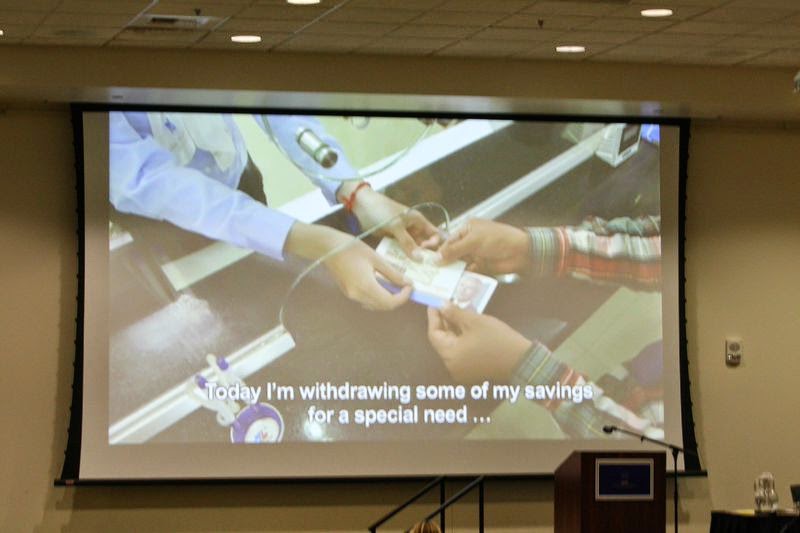

"Mobile Money Financial Literacy via Television Comedy" by Andrew Crawford of Monash University looked at mobile money in Cambodia in the context of financial education campaigns rather than just at the uptake of a particular service, in this case Wing.  Crawford opened by reminding the audience that the financial system had been destroyed by the Khmer Rouge, that US dollars had been used for a period of time afterwards.  Although there were micro finance competitors, Wing -- like M-PESA -- "flows through the economy," and digital currency circulates with loan payments, money transfers, payroll, multi-currency conversion, e-commerce, ATM cards, and deposits.  Nonetheless, financial policy makers were well aware of the problems with mobile money observed by researchers, including the fact that it was expensive to conduct financial education, curricula were slow to rollout, and language and lack of interest issues could stymie retaining and applying information.  (At this point he noted that boredom from conventional presentations like own PowerPoint presentation could cause little to be remembered from his talk.)

Crawford argued that TV comedy could provide a viable alternative to conventional public information campaigns, given that 98% of people in the country watch television and that penetration is particularly high, because many people also watch shows on buses, where corporate synergies between broadcasters, such as  CTN and CNC, and bus companies present opportunities for the Cambodia Microfinance Association and ADA Luxembourg.  Crawford showed several episodes with a couple who progress from very small businesses in barbering and food service to larger enterprises that require more capital and financial planning.  As the relationship matures, along with their banking and credit skills, his hair gradually becomes tamed and his affect becomes less outrageous.

Crawford's research team wanted to find out if there was any impact in both short-term and the long-term financial literacy from watching the show.  Furthermore, can any impact measured in focus groups be extrapolated across wider populations?  The group focused on garment factory workers, because of a desire to focus on women, who represented about 400,000 workers, providing labor for major brands, who were paid in cash with no method to save and thus often remit to family.  In the past the transfer of money was effected via motorbikes with locked boxes, which was inefficient.  Subjects were usually young (in Crawford's opinion often too young to be working full time) and watchers of TV.  The methodology involved three groups: 1) Treatment 1, which experienced generic financial education with a five-minute slide presentation video, 2) Treatment 2, which experienced financial education entertainment with a five-minute comedy show, and 3) Control Group, which experienced a generic comedy show and received no financial literacy education.  Crawford explained that he wanted to combine quantitative research from surveys with qualitative research that involved 1-on-1 interviews with researchers and focus groups after each screening.  Follow up sessions conducted after 3 months to test long term effectiveness Phone surveys – CEO of Wing owns TV station, wife is host of Cambodia’s Next Top Model Country-wide changes – New mobile money accounts, demographics of new clients, general mobile savings trends Novelty Background, Effectiveness, Share results – final research paper


"The Formal Disguise: Financial Inclusion Among Flexible Workers and the Self-Employed" by Ana Echeverry and Coppelia Herrán of Inspira Lab focused on Colombia and the tough competition faced by workers often forced to pay-to-work in positions lacking any social safety net for health and education targeting an unskilled or low skilled labor force, in fields that include outsourced textile production and manufacturing, food and restaurant services, retail and sales, car maintenance and services, and fitness and beauty, where workers often must pay a fee for using the commercial space and bring their own equipment and supplies.  Such workers must often even pay  fees for keeping the place of employment clean, and half of their wages may go to the owner of the commercial space.  Unlike the "temptation costs" described in the previous panel, on this panel Echeverry and  Herrán depict highly disciplined workers willing to invest in the site of employment.  Nonetheless these workers may be extremely disenfranchised.

This team before had worked with "bottom of the pyramid" workers outside of the formal system, but those adopting what  Echeverry and Herrán call "the formal disguise" in many ways are just as desperate as those they had studied before who were using technology through gaming networks and "betting on chance."  Among these barely legal formal workers 43.3% were self-employed, 46.4% earned below the minimum wage, and 50% lacked social security coverage.  The team focused on 24 informants and took a direct approach in public spaces and via referrals with video ethnography and semi-structured interviews trying to the understand the scope of problem.  By interrogating "different views and perspectives," they characterized their work as "exploratory research" about contrasting behaviors and identifying underlying factors driving behaviors, such as values, attitudes, and perceptions.

The group focused on identifying those with contrasting behaviors with a 360 degree view of human personalities that included the careful planner, the risk taker, the person ending a career, the formally trained worker, the submissive economic actor, the spontaneous personality, the risk averse, the independent, the apprentice, the tech-enthusiast, and the technology averse.  By identifying common patterns among diverse people, researchers hoped to identify common strategies and attitudes reflected across personality types.  Informants talked about work, money, and risk with researchers and described an environment of "in and out mobility" instead of "upward mobility."  Such workers depended on using word of mouth and referrals for finding jobs, reliance on social networking, trust, honesty, and willingness to work.  Such workers constantly battled the fact that temporary employment makes it difficult to establish relationships.

This population of vulnerable workers seemed to be avoiding account deductions.  They were not using mobile money, because they realized that the bank takes money, and they also wanted to continue staying below the "fiscal radar" to reduce costs.  Researchers observed a pattern of withdrawing all money on payday and a complicated mental logic in regards to risk.  Their subjects were willing to make certain kinds of investments, even if they did not map onto the conventional architecture of financial inclusion.  These workers might expend pocket money to get better healthcare or divert savings into building home additions for future rental as a retirement strategy.  They might funnel saving towards equipment with hopes of enhanced employment opportunity, but more living those savings went toward financing the inevitable with planning for their own mortality.  In other words, many had little hesitation about shouldering the costs of funeral insurance – in light of their knowledge that this is an event that they know will happen.  Unlike the relatively transparent investment schemes in funeral insurance,  Echeverry bemoaned the fact that 90% of the people subsidized 10% of those who used government services, which fostered a further lack of trust in the system.  Instead workers assumed all risks and operational costs as a consequence of flexible and emerging contracts.  Often workers had to splurge on costly training courses as well.  Echeverry opened by likening many of the country's educational investments to DeVry-style extraction.

Echeverry noted that children become a priority when people are so exhausted and desperate.  The parents researchers studied were willing to do anything for their offspring.  They also were extremely dependent on communication networks, especially those that involve access to word-of-mouth information.  Researchers marveled at the fact that most people in the population they studied had smart phones, which were a "tool for the job."  In fact,"many of them had phones better than ours."  To stay competitive and reduce costs, many opted out of mandatory requirements.  The Inspira team described them as "quite organized," and asserted that "most of them do financial planning."  For such labor-intensive poverty vulnerability the "concern isn’t healthcare but not being able to work."  Thus most can barely afford mandatory insurance services, which would come to about 15% of their income.  Rather than rely on a risky calculus around public health and modern medicine, they were more likely to focus on "protecting oneself from risks" in other ways, including by relying on "religious elements," such as obeisance to the patron of jobs and workers.  Echeverry said that she observed similar behavior in her own nephew around the game Magic the Gathering, which is likewise about rules for "special powers.  These workers in casual labor markets feel compelled to "insure yourself with saints."

Because of government turnover and policy reinvention, researchers have had to delay the implementation phase of research.  Their current action items for lawmakers emphasize an agenda for worker-centered change, which includes the following elements: 1) Offer incentives to compensate for social protection benefits, 2) Provide social dialogue tools that bring together dispersed workers and employers, 3) Offer tools and services that ensure a better future or  living conditions for children, 4) Leverage referrals and social networks into employment services, 5) Make loans or credit eligibility visible to the user, 6) Recommend related products or services into the experience of payroll accounts, such as insurance or investments, 7) Promote add-on complements to mandatory insurance at a minimum, 8) Structural social security reform to include lowering costs through customization, and 9) Promote alternative investments.

To emphasize pragmatic approaches and direct attention to new opportunities for the business sector, the Inspira research team also catalogued a number of "innovation opportunities" that follow from worker-centered principles.  First, researchers discouraged companies from thinking about desktop computing as a platform for Internet and emphasized analogies to social network sites and mobile applications.  For such workers digital recommendations serve a number of purposes, and mobile technologies can also congregate dispersed, independent, and flexible workers to facilitate exchange of services and spread opportunities.  This approach would help workers make informed decisions, and stay up-to-date on legal, insurance and financial topics.  Second, in thinking about money matters, researchers urged financial service providers to offer savings incentives toward specific goals.  For example, in explaining eligibility for loans, allow prospective borrowers to visualize pre approved loans.  Third, companies could develop micro-insurance to provide alternative products that personalize one-sized-fits-all mandatory insurance or respond to specific needs that might be constantly present in workers' imaginations, such as eldercare or high school as expenditures.  Fourth, innovations could emphasize closing the loopholes created by flexible labor laws designed to help Colombians to become competitive in the global market.  Mobile technologies can help workers meet in a place for business relationships, social dialogue, and financial and risk management services.

Listening to Echeverry, I was reminded of the work of Lilly Irani about the flexible workforce that provides so-called "Mechanical Turk" services too difficult for automated computerized AI to be tasked to do.  Irani has had technology workers rate employers to turn the table on systems that before could only rate workers.


Monday, November 28, 2011

Evaluating The Social Impacts of Mobile Money Services in Cambodia

By Jeff Fang

Between March to September 2011, I collaborated with WING Money Cambodia (WING), a leading mobile money services provider in Cambodia, on a research project to evaluate the social impacts of mobile money services in Cambodia.

Currently,WING allows any customers (individuals and businesses) to transfer, deposit (cash-in) and withdraw (cash-out) money between each other and with anyone in Cambodia as well as top up their pre-paid mobile phone credits with their SMS-enabled mobile phones at low cost. Payment transactions like sending/receiving money, phone top-up can be done from any mobile phone, and secured by a personal 4-digits pin code. There is no monthly fee charged for holding a mobile wallet with WING and all the money are safely stored in a regulated bank.

I am both thankful and privileged to be part of this research collaboration with WING. It has been an exciting journey for me to travel to different rural towns to interact with different mobile money community sales representatives, customers and merchants/agents to find out first-hand how WING’s mobile money services has really made positive changes to their small business activities, local cultural norms, social well-being and financial management habits.

Below are 2 customer profile stories which are shortened versions of more detailed interview sessions conducted as part of the current research project collaboration between RMIT University Australia and WING. The names have been left out for privacy concerns.