Showing posts with label markets. Show all posts

Monday, October 2, 2017

Pastoral Adaptation to Market Opportunities and Changing Gender Roles among the Afar in Ethiopia

A report by Uthman Hassen, Adama Science and Technology University, Ethiopia

Map of Ethiopia showing Afar Region
en.wikipedia.org/wiki/Afar_Region#/media/File:Afar_in_Ethiopia.svg

Abstract
This report is an investigation into the major changes observed in the pastoral system of the Afar of Northeastern Ethiopia, their shift towards the market and the application of money and technology, and the subsequent changes in gender relations. A combination of ethnographic methods including semi-structured and key informant interviews, focus discussions, and life histories were used to collect data from 89 respondents in five towns. Complementary data were also collected from additional informants through informal conversations with state officials, civic and clan leaders, sages and academics. It was found that pastoralism is gradually dying, and, consequently, women engaging in the market are increasing both in number and significance. However, their success is hugely constrained by various structural forces, notably state policies, failing laws and processes, lack of formal financing, price fluctuation, and absence of appropriate technology. In the face of these challenges, the Afar women continue to effectively commoditize their pastoral products and participate in wage employment. This shift has further enhanced cash income and mobility. In the absence of formal financial agencies, the traditional sources of capital and money transferring arrangements remain important to the livelihood systems of the Afar people.

Keywords. Pastoralism, Market, Money, Technology, Afar women, Mobility, Ethiopia

--

Who are the Afar? 
The Afar (Afar: Qafár), also known as the Danakil, Adali, and Odali, are an ethnic group inhabiting the Horn of Africa. They primarily live in the Afar Region of Ethiopia and in northern Djibouti, although some also inhabit the southern point of Eritrea. The Afar principally reside in the Danakil Desert in the Afar Region of Ethiopia, as well as in Eritrea and Djibouti. They number 1,276,867 people in Ethiopia (or 1.73% of the total population), of whom 105,551 are urban inhabitants, according to the most recent census (2007). The Afar make up over a third of the population of Djibouti, and are one of the nine recognized ethnic divisions (kililoch) of Ethiopia. The Afar are traditionally pastoralists, raising goats, sheep, and cattle in the desert, are organized into clan families, and are predominantly Muslim. [https://en.wikipedia.org/wiki/Afar_people]


This rich ethnographic report on the Afar is now available, learn about:
  • Their clan relationships, the importance of she-camels, and the feminization of pastoralism.
  • How ethical considerations of the Afar traditions and mobile money affect savings and other monetary practices among the Afar women in the market. 
  • How the Afar view state-backed currency versus livestock as “wealth”.

Excerpt: How the Afar view state-backed currency vs. livestock

“Commerce in the Afar region has been accompanied by two features of a cash economy: sharp fluctuations in the prices of commodities, and the arrival of an active class of merchants in the region. They agreed that for purchasing more tradable goods, there must be more money and favorable orientation to money as wealth. And these in turn depend on the purchasing and exchange value of money, especially for urban households. With very limited investment options, instead of depositing their money in a bank, backyard goat rearing serves as a store of productive assets and an effective strategy to avoid the fast falling purchasing power of money.

Over the years, there have been many variations in the exchange value of money compared against US dollar. The exchange value of money varies at different times, and so it is very difficult for the Afar to conceive of paper money as wealth. For example, just a quarter of a century ago, a qualified teacher with a diploma used to start his monthly salary at a rate of 347 Ethiopian birr. This amount was equivalent to 174 US dollars. Currently, a person with the same profession and qualification begins with a salary of 1663 birr, equivalent to 73 US dollars. The amount could be very insignificant if we calculate it on a daily basis, and much smaller if compared with the cost of basic commodities. For example, two decades ago, a loaf of bread that cost 0.10 birr is now 1.25 birr on average, and, according to informants, the size of the bread is also significantly reduced. These depreciations in the value of money and the rising cost of basic goods are the background for most women who reacted to the very question about money by saying, “Money has no value.”

For the Afar, livestock are self-reproducing assets that generate more value than money in the bank. In fact, conventionally, the value of wealth and assets is estimated by the size and diversity of livestock in rural villages, where maximization and diversification of livestock are the rules. Many informants asserted that they still do not consider money as wealth because of many factors, as an informant, aged 61, mentioned: 
‘The circumstances we have been living for so long were not favorable to have the initiative to consider money as our wealth and actively engage in commerce. It does not have any productive value. It never reproduces itself like our livestock do. We all prefer to own a cow or a goat instead of thousands of birr locked in the bank. The real value of money is controlled by the state, not by us.' 
The Afar’s orientation to money and banking has remained inseparable from the politics and policies of the state. Many informants cited the fact that the first branch of the commercial bank of Ethiopia was opened following the introduction of commercial farms in the area. After this, their livestock and natural resources had been destroyed. Banking and commercial farms are inseparable in the minds of many of the informants. The social meaning of money, locally known as 'genzeb', is more than a medium of exchange and wealth to be accumulated through the market, but rather is a symbol of the power of the state. Many informants echoed beliefs that money has been regarded, by national and regional governments, as a dependable means of buying political loyalties and national integration. Furthermore, as is true for many Muslim societies, the prohibition of usury has always occupied huge spaces among the Afar people. They view usury as establishing discord among clan members by dividing them into borrowers and lenders, and, consequently, destroying the bonds that have survived for generations.” 


Photo caption: Statue built to celebrate the Ethiopian millennium, just 9 years ago, in the ex-capital of the Afar, Aysaita town. Its shape is triangular, representing the Afar nation in three countries, namely Ethiopia, Eritrea, and Djibouti, commonly known as the Afar triangle. Symbolizing the hope for unity, on top of the clock (representing Ethiopia), there are two antenna projections, one pointing in the direction of Eritrea and the other to Djibouti.

Tuesday, August 22, 2017

Financial Inclusion: Integrating the Poor into the World Economy – A Look at Migrant Laborers in a Karachi Marketplace and How They Move Money

by IMTFI Fellow and International Board Member Noman Baig, Habib University

Vendor at Jodia Bazaar, Karachi 
My interest in money stems from the incidents of 9/11 in the United States. After the attacks in the US, all major governments and international organizations passed stringent laws against informal money transfer channels labeled as funding terrorism all over the world. In Pakistan, the state curtailed the illegal funds transfer channel known as hawala by arresting prominent currency dealers and passing the Anti-Hawala Act. A hawala channel is a monetary network/practice that relies on centuries-old kinship bonds for transferring value without moving physical cash from one place to another. In place of these informal and embedded monetary channels, the state opened up a market for multinational corporations such as Western Union and the branchless banking sector to integrate hitherto unbanked people into the gambit of modern finance under the national strategy called “financial inclusion.”

Despite the state’s coercive crackdown on moneychangers and moneylenders in the country’s local bazaars, the lower-income labor class continues to depend on such informal money channels to send and receive money. These personalized networks allow them to feel secure that the money will reach its destination safely. I conducted ethnographic research in Karachi’s marketplace, Bolton Market, the largest wholesale bazaar of a variety of commodities such as skin care, spices, fabric, steel, medicine, etc. While the merchant community was under the direct surveillance of the state security agencies, the laborers were freely moving their funds.

An archeology of funds transfer methods in Karachi’s Bolton Market

Bolton Market, Karachi 
During my research in these markets, I have discovered an archeology of funds transfer methods. I call it an archeology because there are layers of channels, often superimposed on each other, cross-cutting in many cases, and undermining each other at various intervals. It can be called a gradation of financial channels. For example, an informal hawala transfer made through a local money changer passes through a kinship channel, but at some point in a long chain the same transaction will intermingle with the formal banking system. If the transaction raises a suspicious activity report, then the Federal Investigation Agency (FIA) will examine it before the funds reach their final destination.

Jodia Bazaar, Karachi
Financial practices in Karachi’s marketplaces are a lattice work, convoluted, and rhizomatic, making the location of the sources of a transaction by the researcher a dizzying task. In just a single transaction the number of actors involved can include a number of players, such as banks, moneychangers, security agencies, merchants, etc. Sometimes transactions may include shrines, mosques, and charity organizations by virtue of the mere fact that the gift economy and commodity exchange are so tightly knit. Thus it becomes extremely difficult to neatly categorize and differentiate one method of financial transfer from another. In fact, it is also incorrect to use labels such as “informal market,” which according to recent estimates is 75-90% larger than the size of the “formal economy.” To be very clear, “informal” does not mean that the market operates haphazardly, randomly, or irrationally, though it is the kind of impression we generally get when we hear the word informal. In fact, the informal market, if it can be neatly categorized as informal, does not operate outside of the formal market. Both domains intermix with each other at multiple locations.

Bhandari’s story – Considering migrant laborers in Karachi

The research I conducted engages with these multiple methods of funds transfer. One of the channels often used by laborers in Bolton Market involves a kin-based network of largely Pakhtun migrant workers in Karachi.  One of the laborers who I became friends with is called Khan Zareen, also known as Bhandari in the market. Bhandari arrived in Karachi as a porter in the early 1980s. He started working in the city’s vegetable market (sabzi mandi) loading and unloading vegetables and fruit on his back. After the resettlement of the vegetable market to the outskirts of city, Bhandari decided to work in Bolton Market, where he started hauling heavy boxes to and from the warehouse.

Vendor at Jodia Bazaar, Karachi
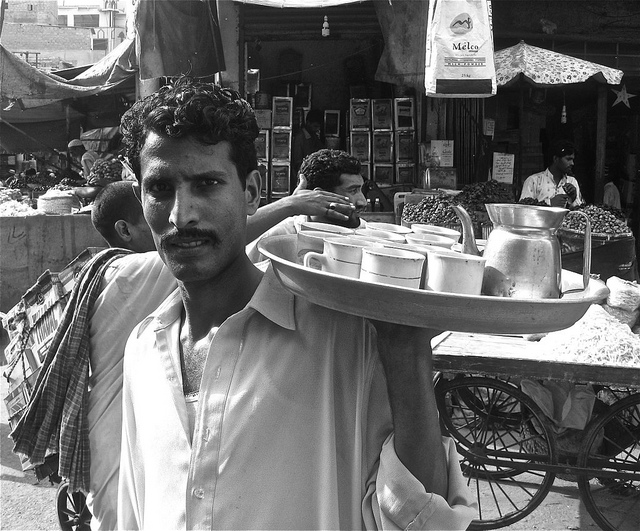
My encounter with Bhandari was sudden and unexpected. One day while loading boxes on the cart to take it to bus station, he came to hear, rather incorrectly, from a shopkeeper that I was a journalist writing a story about the markets. Bhandari came rushing into the office and instructed me to write about his suffering and condition. “Our houses have been destroyed in Bajaur, and we never got any compensation from the government, while the landowners (malik) are constructing new palatial houses,” he said.  These were the first words that Bhandari uttered to me bluntly. Initially I responded to him by saying that I would tell his story, but that he would have to give me more details. As the days passed, we became friends. Every time I would visit Bolton Market, we would go to a chai dhabba (tea shop) for a cup of tea.

One day Bhandari showed me how he transfers money to his home in Bajaur. He took me to another Pakhtun porter, who is known as Laal Zeb. Bhandari handed over cash to Zeb and told him to deliver rice, ghee, wheat, and sugar to his home. Laal Zeb took the cash and called his brother in Bajaur who owns a food ration shop in the village. The next day, Zeb’s brother delivered the goods at Bhandari’s house. There were no fees or charges for any part of the entire transaction. Bhandari was able to buy food items for his family from Karachi, while Zeb collected the cash for his brother’s shop in the village. However, when Bhandari sends cash to the village via a moneylender/shopkeeper, he has to pay Rs. 30 for every Rs. 1000 (which is still half of what branchless banking services such as Easypaisa charge their customers). These are personalized networks operated mainly by village communities who are spread across rural and urban Pakistan. Porters such as Bhandari never go to the bank. Several years ago, with the aid of the state officials, he managed to open a bank account in a local bank branch in Bajaur to receive government compensation for the reconstruction of his house, but after several years the bank account is still waiting to receive funds from the government.

I asked him why doesn’t he use new services such as Easypaisa—Pakistan’s largest branchless banking network—to send money. He replied, “Easypaisa charges Rs. 60, while I pay Rs. 30 on every Rs. 1,000. Also nobody in my home can get to an Easypaisa shop, which is outside of the village.” In conservative tribal areas women are not allowed to go outside alone. Bhandari has no male family members living in the village; his two sons who are 22 and 14 also work in Karachi.

Although Easypaisa has become a phenomenal success among the laboring classes in Karachi, and in Pakistan in general, Pakhtun laborers in Bolton Market continue to use the old ways of sending and receiving money. They use personalized channels such as Laal Zeb not only to transfer value, but also to solidify affective bonds, social relationships, and ethnic ties. These symbolic values play a determining role in maintaining community boundaries. In an Easypaisa store, affective and ethnic relations are rendered unnecessary, while the rationalized market ethos of efficiency, security, and instant transaction takes precedence.

Vendor at Jodia Bazaar, Karachi
Laborers such as Bhandari constitute the majority of Pakistan’s working class who survive on less than $2/day. It is this sector of the population that is seen as existing outside of the “real” economy, the domain of modern, “formal,” rational, and bureaucratic finance propelled by identity cards, paperwork, written records, and a survivalist ethos. The recent financial sector development policies and practices are an effort to bring laborers like Bhandari under the umbrella of the state and the corporate economy through giving them easier access to savings, loans, and credits. One of the ways proposed to implement this is to initiate a network of branchless banking or retail agent banking. The state and corporations justify these efforts as a favor to laborers, a remedy for alleviating their so-called “miserable” conditions through the cure of financial inclusion.

Expanding the Discourse on Financial Inclusion

The agenda of financial inclusion to offer easy access to savings, loans, and credit to the masses, is fraught with inequalities and injustices. This is not to say that the laborers should cease using branchless banking. But to charge heavy fees for the services owned by a foreign corporation proves how terms of trade set during the colonial era continue to extract surplus value from the bones and flesh of the laborers. Most importantly, if international developmental organizations such as the World Bank are seriously interested in improving the financial conditions of the poor by bringing them inside of modern finance, then they should start by identifying the actual root causes of their exclusion. If they want to include these people, then the governments need to start a radical program of wealth redistribution through policies that allow its more even distribution. In other words, the poor masses all over the world are excluded because the wealthy few hold the wealth of 99 percent of the people. The majority will always stay excluded, and any financial inclusion program will fail miserably, unless a just economic system comes into place.

Laborers near Urdu Bazaar, Karachi
The discourse of financial inclusion therefore demands a critical scrutiny in light of the developmental ideology propagated in the postcolonial world. With the beginning of modern colonialism in the mid-eighteenth century, such efforts at integration and inclusion have resulted in an imbalanced power structure and income inequality at a global scale. For instance, in British India, colonial rule forced the integration of the vast land of the Indian subcontinent, and its markets, its weavers and peasants, into the international markets. The outcome was horrendous, and resulted in the siphoning of wealth and resources from the colonies to the metropolis. Thus this is not the first time that a serious effort at integrating the masses into the world economy has been undertaken. The postcolonial world has been experiencing such programs of integration for at least the last two hundred years, often with disastrous consequences.

Stay tuned for a blogpost insights from "Financial Inclusion of the Poor workshop" in Karachi, Pakistan.
Photos credits: Noman Baig 

Wednesday, August 9, 2017

Barriers to a single European payments market: Cultural-economic feedback loops

PERSPECTIVES By Erin B. Taylor, Canela Consulting, former IMTFI Fellow and co-creator of the IMTFI Consumer Finance Research Methods Toolkit

Look into the average traveller’s pockets today and you will find evidence of multiple means of payment. Debit cards, credit cards, traveller’s checks, several currencies, cryptocurrencies, and payment apps are now so common that it seems impossible to run out of ways to pay. Wherever we buy things—on the street, in shops, restaurants, at ticket machines—we have a way to pay. 

As cash falls out of favour, foreigners must switch between different debit 
and credit cards in order to pay. Photo By Erin B. Taylor.

Or so it would seem. In fact, as many travelers can attest, it is still possible to run out of ways to pay. 

Let me give an example. One fine winter’s day in early January 2016, I stopped at a kiosk at the University of Amsterdam to buy a coffee. It was the beginning of my six-month stint as a visiting academic, and the environment was brand new to me. 

I handed the teller some cash to pay for my coffee and croissant, and she looked at me in surprise: “We only accept PIN,” she said. She meant that the kiosk exclusively accepted payment via a Dutch debit card: no cash, no foreign cards—not even European ones. 

I was astonished. Not accepting foreign cards is bizarre enough, but who doesn’t accept cash? As it turns out, a growing number of retailers in northwestern Europe are turning away from hard currency, citing cost and safety reasons. Some stores don’t accept cash, but they accept virtually all foreign cards (debit and credit). Others accept cash and local debit cards, but not foreign cards. And a minority (like my kiosk) exclusively accept local debit cards. 

The unsuspecting traveller may encounter inconveniences not only when trying to pay in the odd kiosk, restaurant, or shop, but also when simply trying to get from A to B. In the Netherlands, an unusually cash-averse society, some parking meters and train ticket machines only accept Dutch cards, and many a traveller has been caught out trying to return to the airport but unable to pay for the fare. Even the simple act of making a meal can involve a complicated series of transactions (see text box at the end of this post, "A Recipe in pan European Payments"). 

This is not just a Dutch peculiarity: payments are a Europe-wide problem. The European common market is meant to deliver the “four ‘f’s”: freedom of movement in people, goods, services, and capital. Theoretically, this should endow people with far more choice as consumers, workers, and citizens. 

Yet despite decades of financial market integration, many consumer finance products and services cannot be readily used across national borders within Europe. This situation could worsen when Brexit is implemented. A diversity of financial systems and a willingness to experiment means that the consumer can never be quite sure what to expect when crossing national borders. Consumers who live, work, and socialize across Europe’s borders can encounter problems using a wide range of finance products and services (e.g., payments, mortgages, taxes, and pensions). Why is this the case?

Some ticket machines in the Netherlands only accept cash or
Dutch debit cards. Photo By Spoorjan (Own work)  CC BY-SA 3.0 

Barriers to integration

One major problem is that the process of financial integration is far from complete. Generally, this integration process is conceptualized as being primarily technological and regulatory. The Single European Payments Area (SEPA) has been largely rolled out across the continent, and the Target Instant Payment Settlement (TIPS)  service promises to abolish waiting times for transfers between European banks. European regulators are working to create legal solutions, such as developing Europe-wide pension schemes, and the Payment Services Directive 2 (PSD2) is due to be implemented next year, further deregulating payments and opening up the market to new players and products. 

However, there are also barriers to integration at the level of the firm and the consumer market interactions, and our understanding of these is threadbare. Some of these relate to market structures, such as pricing. For example, in some European countries, credit cards are not widely accepted because merchants consider the cost to be prohibitive. Other barriers have socio-cultural leanings, such as consumers’ preference for local services, which dissuades them from shopping around the EU, or a preference for using cash in Germany.

These barriers might appear to be either economic or cultural, but closer inspection often shows them to be both. Let me illustrate by way of an example. In an ECB Report, Kokola argues that the Dutch tend to be more averse to credit card debt than their neighbors, whereas Germans are more risk-averse. This kind of cultural heterogeneity influences how financial products and services are developed, marketed, and consumed. 

Such cultural predilections can have deep historic roots. In the Netherlands, there is a longstanding aversion to credit due to historical attitudes towards indebtedness, but bank cards were adopted early on. Because the Dutch are averse to credit, but used to debit cards, credit transactions are relatively rare compared with other countries. And because the Dutch don’t use credit cards much, the cost of credit card transactions remains expensive. Because they’re expensive, merchants don’t accept credit cards, and this reinforces the Dutch aversion to them. 

And so a cultural-economic feedback loop is created.

This lines up with what we know about the interplay between economy and culture globally. Social researchers have long observed that economy and culture are analytically inseparable, no matter what kind of economy people live in. This is easiest to observe in pre-capitalist societies, such as in the use of shell money in Melanesia. 

But economy and culture are intertwined everywhere. In Dreaming of Money in Ho Chi Minh City (2014), Allison J. Truitt discusses how money culture influences what banknotes people will accept (dirty or broken notes are rejected), how money is used for ritual purposes, and many more phenomena that cross the culture/economy divide. In Liquidated: An Ethnography of Wall Street (2009), Karen Ho describes how the decisions of investment bankers are  shaped by their sociocultural beliefs. Nobody, anywhere, is immune.  

The diversity of cultural-economic feedback loops has significant implications for the integration of consumer finance markets in Europe. It suggests that there are hard limits to what can be achieved through technological and regulatory means alone. As Sander, Kleimeier & Heuchemer note, “cultural distance limits international financial integration over and above what can be expected from economic trade and transaction costs.” Even if full integration is achieved, consumers will continue to face limits to their freedom of choice as they live, work, and socialize across European borders.

To understand why there is still no single market for financial services in Europe, it is not enough to look at technical or regulatory matters. But nor can we simply shift the blame to culture. Rather, a cultural-economic feedback loop comes into existence when an economic practice and a cultural practice reinforce each other’s existence. 

The standard EFTPOS machine is fast
being replaced by other POS devices.
Photo By Erin B. Taylor.

The EU’s problem is global

The globalization of payments and other financial services is also creating an imperative to figure out what happens when money cultures meet. Given that so many consumer finance products and services are now available over the Internet, consumers are no longer limited to what is available in their home town or country. Today, we can research and buy an increasingly wide range of savings, transfer, investment, credit, and money management services from anywhere around the world. 

Let’s stop for a moment to consider the irony here. A resident of one European country cannot use their bank card in a second European country, even though there is a single currency and theoretically an integrated payments system. But that same person can buy travel insurance from the U.S.A., invest money in a fund in India, exchange currency using a mobile app based in the United Kingdom, and trade cryptocurrency based in—well, anywhere really.

The problem we face is twofold. First, the integration of financial markets globally is proceeding at different rates in different places. This means that consumers are facing a rapid expansion of choice on the one hand, and the same old limitations on the other. (In fact, these limitations are becoming more problematic because people are more mobile across borders than they were before, and so they encounter these problems more often.) Regulators and financial services providers are over-providing services in some areas, and under-providing them in others. Corporate and government strategies for integrating financial markets need to find a balance between these extremes. 

Second, we have little idea what consumers do when faced with this strange situation. How do consumers work around obstacles to making financial transactions? Do any of the new products and services available globally fill gaps in local services? Why are some people willing to experiment and become “early adopters” of new digital finance products and services, while others remain “laggards” dependent upon traditional banks? And what will a more mature global market for financial goods and services look like in the future? 

Since consumers can now use financial services from around the world, we cannot assume that it is sufficient to approach any of these questions from a local or European angle. In the future, consumers are likely to care less and less about whether the financial services they use are local or not. This is particularly the case when brands that are already globally popular (such as Google, Apple, or PayPal) develop their own range of payments solutions, such as digital wallets. 


A Dutch ATM, fast becoming a rare commodity. 
Photo by Canadian Pacific CC BY-NC 2.0

Mixing methods to understand changing markets

Our challenge is not to get everyone using exactly the same tools, but to create a global ecosystem in which multiple tools and avenues are accepted. To do this, we need to first understand the market. This means we need to design research that investigates how a variety of factors–cultural, economic, regulatory, technical–shape market practices. This holds even if we are trying to specifically understand consumer behaviour. 

Due to the complexity of markets, relying on one single research method (e.g., a survey or interviews) is unlikely to be sufficient for many research questions. Just as financial markets for consumer services are diversifying, so must our research methods also diversify. Understanding consumer choices requires analysis of both qualitative and quantitative factors that influence behaviour, including price, market structures, personal preferences, social structures, and cultural norms. 

This is not news: product developers, designers, and marketers know well that in order to sell something, the offering must hit the right price point and the right “tone” with the consumer. But the shift to Internet-based and mobile consumer finance services presents a challenge because the transition is incomplete and the market is highly complex. 

While little can be done to predict how regulations will change, it is certainly possible to improve our understanding of changing consumer behaviour and thereby generate more robust market knowledge. As we discuss in the Consumer Finance Research Methods Toolkit (CFRM Toolkit), researchers from both industry and academia are innovating new ways to record and analyze the financial behaviours of individuals and households. 

Ethnography, interview methods, financial diaries, online/offline studies, experiments, and so on, are all being reconfigured and combined with other methods to account for the increasing mobility products and services through accessible digital spaces and technologies. Adapting and combining methods offers substantial potential to generate detailed data on a variety of cultural and economic problems. This is because they either include ways to collect qualitative and quantitative data simultaneously, or because they can be easily incorporated into mixed-methods research. 

Combining interdisciplinary thinking with mixed methods gives us a chance to understand the cultural/economic feedback loops that are shaping the emergence of a new generation of consumer financial practices and markets, not only in Europe, but around the world. Regulators, service providers, and researchers are best placed when they take this range of factors and geographies into account. 

Wednesday, October 21, 2015

Revisiting the Fishers of Kerala with Janaki Srinivasan

In March of 2015 IMTFI arranged for a comprehensive visit to India to gather updates on four of their sponsored research projects, introduction can be found here. This final of four case studies takes a look at Kerala fishers with Janaki Srinivasan.


Janaki Srinivasan of the International Institute of Information Technology Bangalore is interested in interrogating two major trends in digital culture today: "info-determinism" and "disintermediation." She had always been "interested in intermediaries, the importance of how the intermediary was introduced, and why he is always a villain. For example, why is the human auctioneer in the fish market perceived as an obstacle?" In our conversation, she also cited the work of Elisa Oreglia on the value of intermediaries and "how to re-embed them in market information systems" and grapple with "a sensible way to make them useful." She explained how just as technological determinism assumes that social development depends upon progress dictated by a history of novel inventions, informational determinism assumes that adopting new data paradigms (such as policies around transparency, open access or large-scale data mining) will necessarily transform society. 

The gradual removal of intermediaries in this schema is often understood as a part of this transformation. For example, even as the Indian online mega-store Flipkart puts many neighborhood merchants out of business, it is still lauded by enthusiasts for streamlining the labyrinthine supply chains of the country. In this regard, Srinivasan draws attention to the massive international Global Impact Study which has done the important work of documenting the role of so-called "infomediaries" around the world. In this study, the researchers found that many people did not prefer direct and unmediated access to information from personal computers. Whether it was information of interest about agriculture, health, or other topics citizens often preferred greater social transactions that involved local experts, authorities, and mediators serving as go-betweens. (The Global Impact Study was a groundbreaking and wide-reaching study funded by the sponsorship of Canada’s International Development Research Centre, and a grant to IDRC from the Global Libraries initiative of the Bill & Melinda Gates FoundationThe Dean of IIIT Balaji Parthasarathy, who is also one of Srinivasan's colleagues was a co-Principal Investigator of the study). 

Srinivasan argues that technology sometimes may introduce hierarchies rather than level them and technological innovation may not necessarily deliver the promised efficiency, access, participation, and social good. Working with Jenna Burrell, Professor at Berkeley and Richa Kumar, Professor at the Indian Institute of Technology-Delhi, Srinivasan presented her initial findings in  2012 on "A Work Practice Approach to Understanding Actors in Agricultural Markets: Revisiting the Fishermen of Kerala, India." (blogged here, Kumar has also done research on eChoupals.) 

In this project, this core group of three scholars were interested in testing the hypothesis that access to price information via cell phones would simplify transactions at fish markets and make the operation of the market fairer, more transparent, and less wasteful for all participants. (Conference paper at ACM Digital library can be found here).


In the intervening years since the beginning of the project in 2012, Srinivasan and her Bangalore colleagues have been busy with launching a new M.S. program in Digital Society. This YouTube video explains how this novel degree program is intended to bring social scientists, technologists, and designers together to build research and analysis that would take into account caste and gender in tackling development, health, and sustainability issues. The faculty at IIIT plan to work with an interdisciplinary cohort that is "not only corporate nor only government."     

Srinivasan's initial doctoral research impetus to examine digital delivery systems came from her interest in how the "right to information" was imagined. "In my dissertation, I compared two information-focused initiatives: one a political Right to Information campaign, another an 'apolitical' village information centre project." She "was looking at this whole idea of information as a development tool" and the competing interests of "different political actors." She noted that "info-centre projects categorically state that they don’t want to be involved in politics," even though case studies indicate that in reality it is difficult for ICT (information and communication technologies) initiatives to remain completely politically neutral. (To learn more about ICT efforts go to the National Informatics Centre.) 

Srinivasan began her analysis of ideologies about information by examining the history of right to information campaign in India. She observed that unlike lobbying for the Freedom of Information Act in the United States, which was led largely by journalists, India's 2005 Right to Information Act was the result of fifteen years of grassroots struggles spurred by the efforts of minimum wage laborers who had not received their wages for their work on public works projects.

Srinivasan recounts how prior to the legislation, citizens' access to many such public works projects were ostensibly limited by official secrets acts. There were also times when officials could use distinctions between paper and electronic records to prevent public review. The 1996 rallies in Rajasthan were critical for spurring the legislation. These demonstrations called for the locks on government files to be opened, and villagers demanded access to "entire journals" that logged data. According to Srinivasan, organizations like the M.S. Swaminathan Research Foundation (MSSRF) established in 1988, were intended to play an important role in raising consciousness by launching the Information Villages initiative. These organizations were, however more interested in the provision of information rather than conceptualizing it as a right. Although a supporter of such transparency initiatives, Srinivasan remains skeptical of the idea that digital transparency alone would be sufficient to level economic inequities. 

For this project, Srinivasan, Burrell, and Kumar decided to empirically analyze Robert Jensen's "The Digital Provide: Information (Technology), Market Performance, and Welfare in the South Indian Fisheries Sector," a famous study on Kerala fishermen which argued that universal access to information could have transformative effects on bottom-of-the-pyramid workers. Jensen's study had focused specifically on the effects of the introduction of mobile phone service throughout Kerala from 1997-2001 on fishing communities. In the book, Jenson makes the claim that "Using microlevel survey data, we show that the adoption of mobile phones by fishermen and wholesalers was associated with a dramatic reduction in price dispersion, the complete elimination of waste, and near-perfect adherence to the Law of One Price. Both consumer and producer welfare increased."

Srinivasan appreciated the fact that Jensen had done a good job of providing detail" in a study "done over time," and the research team decided to revisit and interrogate Jensen's paper written 15 years ago. Noting that social science research wasn't necessarily reproducible in the way that other kinds of scientific research might be, she emphasized that Vizhinjam was "not a place frozen in time" and "not a controlled experiment." Srinivasan was also interested questions that Jensen brought up in terms of "wastage." The team found themselves asking somewhat different questions based on their observations: "If you do eliminate waste, who are the people who get affected?  The fish are never wasted in terms of being thrown back into sea." Although they might not circulate in formal markets, the fish have an afterlife in "home-based drying, salting, or processing."

Being interested in "the thinking behind the project," the researchers found themselves with "similar questions" about phone use in fishing communities but different questions regarding the roles played by "class, caste, and gender" in the busy markets. They were also faced with the challenge of "how to operationalize" their questions in an in-depth study. The researchers revisiting Jensen did go to one of his three sites in northern Kerala, Chaliyam, but they thought it might be valuable to acknowledge the fact that Kerala has 500 kilometers of coastline and that there were significant differences "in fish, in vessels, in credit relations, and who they sold to" across the region.


Srinivasan was also curious about why there was "no mention of gender in Jensen." The team realized that "women did not participate in the North at all; in the South there were a lot of women." The economic importance of women in other ways was evident around Vizhinjam. There were a number of establishments that offered a credit market to those able to liquidate holdings in precious metals, especially gold accessories that were marriage gifts. (For research on gold loans and importance of wealth stored in women's jewelry see IMTFI researcher Joseph's work here). 


Srinivasan's team chose Vizhinjam to the south of the state of Kerala renowned for tourist beaches as well as fishing expertise. She added further that "Kerala has centuries of history with a long relation to migration, including movement to Gulf states. You acquire connections that make you cosmopolitan. I found it interesting because the older generation in the region had in reality traveled and had ties especially in the Middle East. This gap between perception and reality I found very telling."


Srinivasan described the initial challenge of making sense of the complex scene at "an auction where everyone was bidding for piles of fish" and it was difficult to track "fishermen’s movements." She chuckled about the "chaos on that first day" and at coping with the "decibel levels." She recalls how "monitoring digital platforms, the formation of identities, and caste groups proved to be much more challenging than generating abstract and elegant 'equations' divorced from the messiness of reality. There might be fifteen auctions at the same time, with people pushing and shoving."


Srinivasan described how the Vizhinjam field site differed from where she had worked in Pondicherry where the MSSRF information centers dispensed information about government schemes through kiosks, public address systems, or websites rather than text messages on mobile phones. There she had been struck by "how categorically they wanted to divorce their activities from politics," even though "everyday politics operating in the village" made the "universal idea of information being good" was complicated by the "facts that information was A) not just one thing and B) of course it is political."

The research team also reviewed existing literature about the economic behavior of farmers around price information even though fishermen who are landless by profession, face specific difficulties different from that of farmers especially with regards to access to credit. (For more on farmers, prices, and information, see our story about IMTFI researcher Nithya Joseph and her research on silk markets).


In mapping economic relations the team also realized that when working with "the category of producer and consumer" it was often assumed that the two parties "did not actually interact," despite the apparent disintermediation of their transactions by access to cell phone data. Hybrid characters like the invester/auctioneer proved to be "critical from a design perspective" in understanding "different actors, kinds of phones, where did the auctioneer come from, and at why price information would even matter."(As a case in point IMTFI researcher Mani Nandhi's study focussed on credit relations available to rickshaw pullers in Delhi which shows that gaining access to credit could involve coercive financial relationships as well).


In understanding how fish market transactions operated in the 60s through the 80s, "it might be easy to see these earlier relations as exploitative, because it was not a freely operating market; it was one that was structured in particular ways, and social campaigns and government interventions were not equally useful." But the introduction of cell phone technology didn't necessarily make the market more democratic, Srinivasan argues, because of distinctions between "large vendors vs. small vendors." In other words, according to Srinivasan, "the bigger you were as a player, the more important price information was. Huge volume was needed, when we represent something as regulating and operating by economic laws. What about its history allows the market to operate and mobile phones to be useful? For me it was a useful extension to my dissertation," which looked at how information worked as a development tool for a political movement and an NGO-based initiative, as a way to represent "a free market conception of development and how the world works" and apply it to a case in which "a free market conception of development used information as a development tool."


Srinivasan noted that in 2013 "the fisherman are not really literate, although the state has high literacy; many had learned to make use of the phone's calling function, or they would remember the last two digits" to pick out the right number from a contact list. Some kept notebooks, because even if they were not literate they were numerate. Cell phones weren't only used instrumentally for economic purposes but "they used mobile phones for music out on the sea." Their social connections between the fishers were also much more than merely transactional.  Srinivasan pointed out that even the youngest fisherman or auctioneers maintained traditional ties with the church tax collector, which were often enhanced by new technologies rather than weakened by them. A younger fishermen and the young church tax collector from a fisher family said that "Facebook was important as a way to connect with the world; it was different from their parents' generation, who were from a close set of people with no ties outside of village.

In their research the researchers have worked with local informants and translators in the field site to map a dense multiplicity of economic relations in which there were many types of producer, many types of consumer, many uses for cell phones, many different types of equipment for fishing. Among the many actors in the scene one would find auctioner/investor figures and export agents, wholesale agents, fish vendors, waste procurers, and even local religious leaders. 


For my visit, the researchers had provided me with images that were intended to map the dense network of participants in the harbor who were engaged in the buying and selling of fish as well as many other kinds of transactions. From the research team's photographs I recognized the mosque and church that shared the Vizhinjam skyline with tall palm trees. Vizhinjam is not very far from the regional capital of Thiruvananthapuram, which has a busy international airport and a vibrant political culture that had shut down the streets during my visit. Anticipating political disturbance on the street I waited to visit the docks until Sunday, a day when most of the activity focused on the maintenance of boats. On the quiet Sunday when I visited Vizhinjam, the main auction was closed and churches were holding services, there was plenty of activity around the marine food supply that ranged from managing family economics to the transactions of small roadside vendors selling meat who were doing brisk business. (Find IMTFI funded work on how small ruminants like goats function as a form of capital among those who live on less than a dollar a day here)


Srinivasan also pointed out that "whole idea of collaborating closely on ethnographic research" involved a lot of coordination among the three researchers who were in different work environments. For instance Burrell was yet to visit the field site at the time of the interview. Nonetheless the group was able to have what Srinivasan described as a deep and lasting conversation about methodology as they stayed in touch through frequent Skype calls. "There were things we wanted to discuss throughout the process and recent things that emerged from the nature of the collaboration." Each saw the field site from her side through "disparate pictures and field notes" but also supplemented the research with new expertise. "Richa had worked with farmers in India and had seen how information circulates in that context, which was tremendously useful." Of course, she admitted that there was sometimes "ethnographic confusion" and many challenges in trying to get "a complete picture in three months" even as each of them would "jump in with questions." Srinivasan said "as a methodological path, it very useful, even if the connectivity was not always ideal. We started with plan of Skyping two times a week, and Jenna would read our notes and come up with set of questions. Jenna did a fantastic job on figuring out the political economy of the region."


In conclusion, Srinivasan shared her interest to work on mobile payments and exploring questions regarding gender, particularly as she has personally encountered stories of women and the work of Lilly Irani about what counts as computing. As the MSc Digital Society program gets underway, she continues to pursue multiple collaborations, including "putting our students in touch with CIS," the Bangalore-based Centre for Internet and Society. Srinivasan has also begun thinking about the possible repercussions of the AADHAAR biometric identity card as another case study for exploring info-determinism, "it's interesting to think about biometrics as an ideology, about agents and enrollments, about the nationwide rollout of standardized numbers, who will come up to enroll, what documents of identity will be accepted, and how intermediaries will function."AADHAAR promotes what she calls "the idea of a stable identity" while overlooking "people’s desire to negotiate their visibility to the state." She is also enthusiastic about working with other collaborators, as she develops her ideas about info-determinism, which might be "even bigger than technological determinism as a bias, because it ignores social structures, ignores the agencies of people who do something with the information."

Srinivasan, along with Elisa Oreglia, will be joining the next cohort at IMTFI Fellows to develop new research in,  "Intermediaries, Cash Economies, and Technological Change in Myanmar and India." Initial findings will be presented at the IMTFI Annual Conference, coming to UC Irvine in April 2016~stay tuned!


[Photo Credits: Janaki Srinivasan and Elizabeth Losh]

Monday, October 19, 2015

Silk Workers and Gold in Karnataka with Nithya Joseph

In March of 2015 IMTFI arranged for a comprehensive visit to India to gather updates on four of their sponsored research projects, introduction can be found here. This third of four case studies takes a look at silk workers in Karnataka with Nithya Joseph.

Devika Raman and Nithya Joseph with silk workers (middle, left to right). 
Like many of the other IMTFI researchers working in India, Nithya Joseph began with research questions around microfinance initiatives. "I was actually looking at microfinance in the Bangalore area and translating for a Dutch anthropologist. We were thinking about group solidarity in microfinance and which groups were supposed to be success stories." She was sent to study Ramnagaram as an example of a branch that had been an overwhelming success. "A year later there was a crisis in the town; all the Muslim borrowers had stopped repaying."

Joseph described how she came to understand structures of "multiple borrowing" that "were both about competitive microfinance and the about the ways in which the silk industry was itself structured and how debt relations were arranged." As Joseph explained, "it seemed like the most vulnerable women were the ones working in the silk industry, the ones not able to benefit from microfinance." She ascribed the reason for their condition in part to overlapping social roles occupied by key players in which "religious leaders could also be the silk factory owners," so that their "unhappiness and frustration" might be directed toward "competing source of credit," particularly when proprietors already "had to give more credit for loans and advances," and so "while they were supporting the revolt against microfinance as a way of protecting women from exploitation, they also stood to gain if their labor lost an alternate source of credit and continued to be dependent on them." She started out her doctoral work, in the same town, studying debt-based labor contracts in silk-reeling before extending her study to capital accumulation across the silk industry through her IMTFI research project.

"IMTFI brought a grounded anthropology aspect to the work. Coming to the conference encouraged very particular ways in which to think. It allowed me to bring a completely different discipline to the work. One direction in which I would like to work is the materiality of capital. There are all these relationships in studies of the political economy of India," For Joseph these relationships included "how social relations organize the economy." She noted that "gold offers ways of mapping the relationship between capital and people; because any surplus income tends to be stored as gold, mandated by social pressures to own gold, and gold is often mortgaged both for reproductive needs and for investment in firms.” She would like to map gold ownership, other forms of capital, and indicators of well-being together across time and space, to really look and understand what these networks mean in terms of livelihoods, health, education, gender, and violence."

As she completes her doctoral dissertation on these topics, Joseph has been working closely with research mentors Isabelle Guérin and Loraine Kennedy, who is a CNRS research director at the Centre for South Asian Studies (CEIAS) at the EHESS, Paris. Guérin had helped her revise her master’s thesis, on the micro finance repayment stand off, for a book she was then editing. (You can read about Guérin's work on indebtedness, juggling, and calculation frameworks here.)


With Joseph as our guide, we began by tracing different aspects of the production cycles of the silk industry, starting with the giant Ramnagar Market in which Hindu farmers come to sell their bins of cocoons to Muslim reelers. The auctioneers ticked off numbers rapidly as transactions escalate and de-escalate, and only veterans of the market attuned to the complex choreography of gestures associated with established relationships that called for interpretation had the discerning set of skills required for the purpose. 

As an IMTFI researcher, Joseph brings a unique background from her affiliation with the Srishti Institute of Art, Design and Technology, where she facilitated research methods and creative writing courses. She explained how "design" was construed very broadly at Srishti and how she had conceived her master's thesis on debt relations." Srishti was an open space. There was a lot of freedom with course design and there were a lot of initiatives that engaged with local and national issues. I had no background in art and design, and it was exciting to work with students who could take ideas and translate them into visual terms."


Because the cocoons represent a serious investment for many farmers, they often sleep under their lots. It is a largely male environment -- with only a few Hindu female participants and no Muslim women -- in which men socialize before the auctions begin. Muslim reelers have a designated waiting room, which was unused at the time of the visit. There were also fewer buyers on that day, according to Joseph, because of Friday prayers.

A system in which farmers receive text messages via cell phones about baseline prices apparently encourages many to travel considerable distances. As one farmer observed, "it gives us hope because we know what price we’ll get when our cocoons are ready and also which town’s market will give the best price." Although we saw both smart phones and feature phones in use, buyers and sellers generally focused on face-to-face interactions and attending subtleties of how a buyer examines his cocoons.


The set practices around transactions relied on paper records, which fluttered inside the large barn-like buildings as the human activity became particularly animated. Transaction slips were transcribed into ledger books. Much of the assessment seemed to be based on visual and tactile interaction with the cocoons and decades of experience. Digital scales assayed the weight of the cocoons only at the end of the process.


Far away from the action in a quiet room with a host of computers, the government managers of the silk market were busy in their digital control room. Unbeknownst to many in the market, plans were afoot for complete digitization of the transactions. Those without cell phones would be given tablets, so they could continue to participate in the system. 


Digitizing the cocoon market raises a number of interesting research questions about the relationship between technological innovation and inequality, and Joseph looks forward to documenting how the "before" and "after" will play out for participants. She hypothesizes that those already comfortable with the use of smartphones might welcome these changes, while those who are less comfortable may find it difficult to shift to the e-auction.


Agents from the agricultural ministry have already done considerable outreach about technological enhancements to sericulture and deliver lectures on best practices to those interested in improving their crops. This has reduced labor requirements and significantly improved productivity in silk cocoon production.

Some families have been cultivating the crop for many decades and they are well-versed in the paper record-keeping practices that assure receiving government subsidies. They express confidence that technology allows rational decision-making, particularly about traveling to a market that may be as far as 400 kilometers away. In contrast there were other families who had been farming silkworms only for a few years. Although these families may be closer geographically to the market than many other farmers -- only traveling about a dozen kilometers -- they may be unfamiliar with market procedures, particularly using the text message pricing system and getting registered to receive the information.


Certainly it will be interesting to see how technology changes the dynamics of the market and how it impacts financial inclusion. (For more on the theme of disintermediation, stay tuned this week when we revisit the work of IMTFI researcher Janaki Srinivasan on this blog.)  When the cocoons are bought at the market, they seem to be "taken out of informal markets" in these "almost entirely open auctions in which everyone is present," but Joseph cautions that everything is "not as transparent as it appears," because there are "pre-negotiated prices, and people come to make arrangements and deals."  Even if "it seems like those transactions are quite open and visible, the spaces where it is not are still interesting."


To begin to understand the importance of mechanisms for savings and credit, our next stop while revisiting Joseph's field sites was a street with thirty-five jewelers. We encountered several groups of women purchasing jewelry for weddings. As Joseph explained, "I started looking at gold after going back and looking at inequality." She described an assignment at Srishti that asked participants to bring in different articles. Her interest in gold grew out of an assignment for her research methods class studying inequalities for which a student -- whose father is a jewelry shop owner in in Uttar Pradesh and who had watched people buying gold -- chose to study gold ownership. He was interested in questions like "Who is making decisions regarding purchases?" and "Who will own and have control over the jewelry?" What does this purchase mean for the family?" The student was a non-Kannada speaker and was also finding that "as a male, it was difficult to do interviews on gold ownership" so she met him before college every morning to translate for him. She described the interviews as "really interesting" because it became clear that "gold is tied to so many aspects of people’s lives."

"Some of the household scenarios in the interviews were very dramatic. People were really struggling." Joseph heard stories about abuse, alcoholism, and misogyny, but in some cases gold gave these women hope by making available assets that they controlled that could be used to pay for their daughters' medical care and educations. However, Joseph notes, "it’s double-edged: having gold helps in such situations, but the requirement to own gold and give dowries puts immense pressure on girls and their parents." Joseph pointed out that "objects of gold jewelry can be symbolic of the ways in which relationships are valued." She told how friends might buy earrings for each other as a way to express their close social bonds in which "I bought hers, and she bought mine."


As Joseph articulated in her IMTFI presentation in December 2013, gold serves as an important source of capital in the silk industry, one which is often more important than financial services offered by the banking sector. However, formal and informal financial mechanisms are merging as many more conventional service providers are offering "gold loans" that present an alternative to pawn brokers.


Gold jewelry is appraised on many factors, so the value of the metal as a commodity may be less important than the workmanship and appropriateness of the design. Muslim customers and Hindu customers may also favor different jewelry fashions. As more customers and craftsman are using smartphones, multiple-party consultations using platforms like WhatsApp can refine consumer selections as well. 


Jewelers actually offer a number of different financial services, in addition to sales, purchases, and loans around gold. This woman pays money into a special savings account that not only gives her interest but also offers a regular draw in which participants can gain additional winnings. (See our interview with Dan Radcliffe for other ideas for incentivizing rational financial behavior with irrational expectations).


Even the poorest women were mindful of the importance of gold loans. In a sorting area for some of the lowest wage worker who clean silk waste, women described how gold loans were critical for paying home-building and other expenses, such as dowries for daughters. Even from these very poor participants we heard thanks to the government's financial literacy efforts -- some already had no-frills zero-balance bank accounts and chose to approach the banks for gold loans. Others chose to pay relatively high interest to local pawn brokers, which at a whopping 24% interest rate could contribute to spiraling debt, but they appreciated the flexibility and ease of negotiations of working with a more informal relationship.


Those who availed of gold loans from private financial institutions specializing in gold loans commented that they often offered lower interest rates but less flexibility. Gold loans could be important for building costs, medical expenses, and many kinds of liquidity requiring situations although they could make saving for serving the loan more frustrating for the borrowers. Although the fact that financial services companies may send text messages to alert borrowers in time to prevent interest accruing on compound interest, gathering money to forestall this could be stressful for the participants.


We also visited the home of a factory owner, who had been impacted by new mechanization imported from China. In Joseph's IMTFI presentation she detailed how liberalization of silk markets had largely been negative for this sector because it implied competing with cheap imports from China, although some people were better able to withstand the shock than others. Thus liberalization could lead to an erosion in traditional status for those struggling to adapt with less liquid capital resources. Many had recounted to her "with Chinese silk we lost our gold immediately." The family of reelers offered their generous hospitality to us and fondly recounted the recent marriage of a daughter who had a considerable gold trousseau as seen in her, as shown in her wedding video.  


Several days earlier, before visiting the field site, Joseph had presented a paper at the 17th Workshop of the Association Jeunes Etudes Indiennes, which focused on "Gender: Politics, Labour, Law, Development" at Banaras Hindu University in Varanasi, where the silk supply chain came another step closer to the consumer market in a city known for its long tradition of weaving luxury silk goods. In this way, we notice how the product moves from Hindu farmer to Muslim reeler to Hindu weaver. Joseph's paper, "And our ears have been empty since then," showed how she is continuing to refine her work on gold ownership, gender, and work vulnerability in South Indian silk-reeling hub. While in Varanasi she had a chance to visit handloom weaving units, which earlier bought raw silk from Karnataka but were now buying Chinese silk and synthetic yarn instead.


Workers in reeling factories might receive loans conditional to perceived moral character, in addition their quality of work and years of service. As Joseph explained, "access to credit is complicated; there’s a spectrum in terms of how people are able to manage this credit, and how they might not have a productive way to use it. With new forms of financial transactions that they are not familiar with, transactions can spiral out of control. In informal systems, people are able to negotiate and discuss."

Traditionally the silk-reeling business "is seen as being unskilled and low paying work" with "very little capital investment needed for the equipment, but with high variable costs - working capital requirements - because the cocoons are very expensive." Joseph had noticed that the factory owners were expert in many tacit knowledge practices gained by "being able to gauge the quality of the cocoons, being able to do the work quickly and efficiently."

With growing competition from machine-made imports, there might be pressure on both employers and employees to consider exiting the industry.  However, employers' capital is locked into advances they’ve given employees and employees can’t payback the wages advanced as they have no alternative skills." Even if one is operating on the margins, it is very difficult to stop, especially if one is not familiar with being outside the town.

Although we weren't able to visit the factory with the new Chinese machines Joseph did show us how at the bottom end of the economic spectrum were producers of raw silk. In these establishments owners and their families worked in the factories with few, or no, employees.


Religion and culture often played a role in financial dynamics and dilemmas. Joseph characterized her field site as "a Muslim area in which women working outside the town are not encouraged; there is difficulty to access alternate employment even if it is available." Silk-reeling now attracts very few new employees; the work is physically difficult, with long hours with your hands in water, so they become puckered and blistered. Typically those who work in silk-reeling are individuals who either have high-debt to the industry or enter because they need credit from employers. The difficulty of the work and the health hazards discourage entry." Unlike other IMTFI researchers working on Muslim financial transactions, such as Amrit Pal, hawala was not a major concern, because "it was all very local in terms of payment channels." Muslim research assistants and informants remained emotionally close, despite not frequenting the town on a regular basis. (For other projects related to Muslim financial transactions see Bridget Kustin's "Mobilizing Religion as Value Storage: Islamic Microfinance in Bangladesh for Poverty Alleviation" and Rosina Nasir's study on "The Association of Social Capital with Microfinance and Local Savings Programs among the Muslim Poor in Hyderabad".)

Although Joseph is busy trying to finish her PhD and balancing the suggestions of a political economist and a social economist as supervisors, she is interested in expanding her work on mapping these financial transactions because she is interested in "listening to how people and assets have moved across space." As she visualizes this map, Joseph feels that it's important to keep in mind the whole production chain and understand how the different social groups engaged in each process relate to their ability to accumulate capital.

"I’m also interested in the materiality of silk through the various stages of production… the worms are considered sacred by their rearers, and the final silk product is considered to be pure and used for auspicious events while the process of reeling which happens between these two stages and involves the dead worm is seen as being unclean and employs marginalized groups, and the stigma associated with the work and the low value added at this stage reinforce marginalization, whereas higher caste groups are engaged in the other processes, and they are able to negotiate a higher percentage of profits."

We passed a shop displaying festive decorations that were made of cocoons, which were often worn by local Muslim politicians, celebrants, or other prosperous citizens while Hindus do not make use these garlands.


[Photo credit: Devika Raman]